
Characterizing smoke emitted from extreme biomass burning events over Indonesia in 2015 using satellites observations from the A-Train
This event has passed. See the seminar recording here:
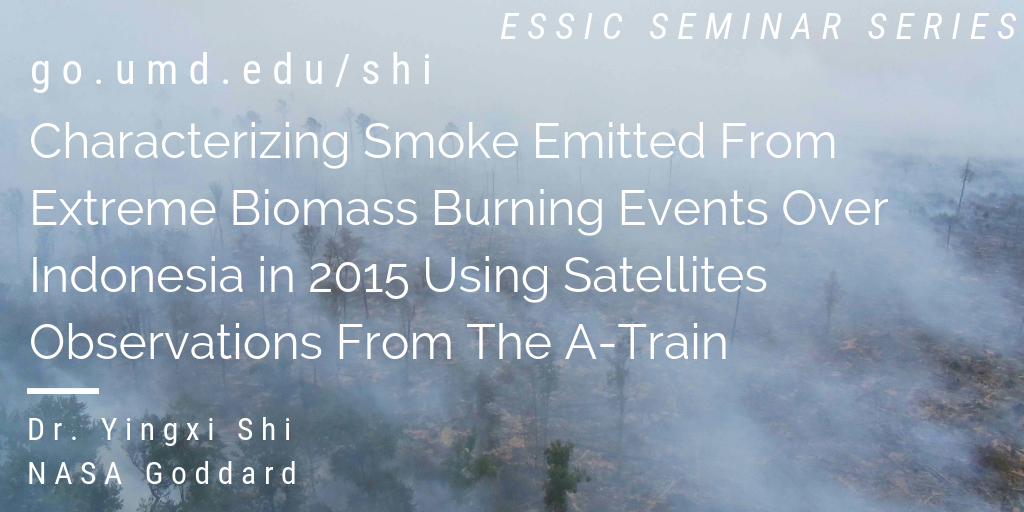
Dr. Yingxi Shi
NASA Goddard
Monday September 24, 2018, 12:00-1:00 PM
ESSIC Conference Room 4102, 5825 University Research Ct, College Park, MD 20740
Abstract:
The Indonesian forest fire and smoke event of 2015 was an extreme episode that affected public health and caused severe economic and environmental damage. The MODIS Dark Target (DT) aerosol algorithm, developed for global applications, significantly underestimated regional aerosol optical depth (AOD) during this episode. The underestimation was due to both an overly zealous set of masks that mistook heavy smoke plumes for clouds and/or inland water, and also an aerosol optical model developed for generic global aerosol conditions. Using Aerosol Robotic Network (AERONET) Version 3 sky inversions of local AERONET stations, we created a specific aerosol model for the extreme event. Thus, using this new (less-absorbing) aerosol model, cloud masking based on results of the MODIS cloud optical properties algorithm, and relaxed thresholds on both inland water tests and upper limits of the AOD retrieval, we created a research algorithm and applied it to 80 appropriate MODIS granules during the event. Collocating and comparing with AERONET AOD shows that the research algorithm doubles the number of MODIS retrievals with AOD greater than 1, while significantly decreasing uncertainty. The research product shows that the operational DT algorithm underestimated regional mean AOD by approximately 0.22, but by as much as 3.0 for individual 0.5° grid boxes. The impact of missing high AOD retrievals on the regional aerosol climatology is studied using this newly-developed research product. The aerosol direct radiative effects and atmosphere heating rate over the Indonesia region were calculated using Libradtran. Our study shows slightly increased aerosol cooling effects at surface and TOA and increased heating rate at altitude where aerosol exist.
Bio-sketch:
Dr. Yingxi Shi is an Associate Scientist working at USRA and NASA GSFC Climate and Radiation Laboratory. Her current research interests include retrieving and characterizing global aerosol properties, with a primary focus on quantifying heavy aerosol loading. She has experience in developing and evaluating of satellite aerosol products and applying them in aerosol data assimilation. She joined USRA as a Postdoctoral Research Scientist after earning her PhD in Atmospheric Sciences from the University of North Dakota in 2015.
Webex info:
Event number: 738 801 981
Event password: essic
——————————————————-
To join the online event
——————————————————-
1. Click here to join the online event.
Or copy and paste the following link to a browser:
https://umd.webex.com/umd/onstage/g.php?MTID=ec7331f6156a77132a45205420cda0ee4
2. Click “Join Now”.
——————————————————-
To join the audio conference only
——————————————————-
US Toll: +1-415-655-0002
Global call-in numbers: https://umd.webex.com/umd/globalcallin.php?serviceType=EC&ED=673740507&tollFree=0
Access code: 738 801 981
——————————————————-
For IT assistance
——————————————————-
Contact Travis Swaim at: tswaim1@umd.edu
Follow ESSIC:
ESSIC homepage: http://essic.umd.edu/
ESSIC seminar: MSQ-4102; http://go.umd.edu/essicseminar
ESSIC twitter: http://twitter.com/ESSICUMD
ESSIC facebook: http://facebook.com/ESSICUMD
ESSIC seminar coordinator: Dr. John Yang, jxyang@umd.edu