University of Maryland

Pacific Northwest Atmospheric Rivers & Catastrophic Flooding

UMD/ESSIC/CISESS GOES-R Satellite Liaison for NWS WPC

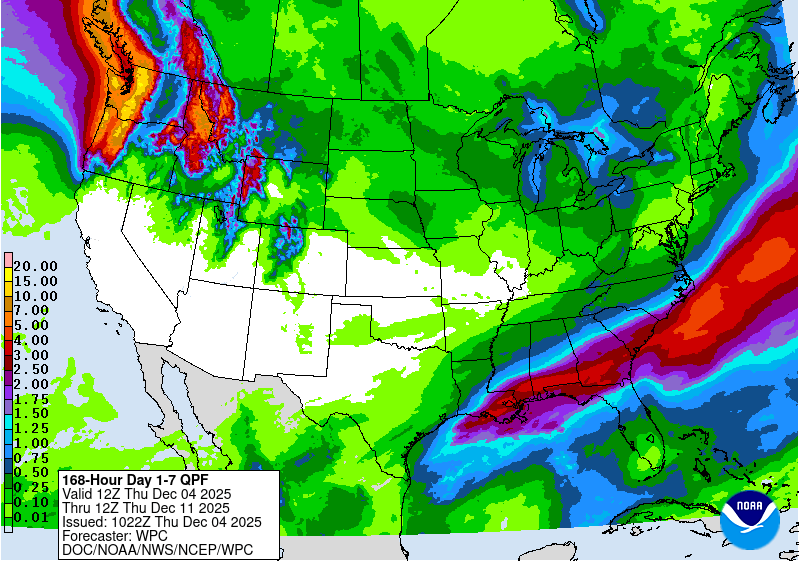
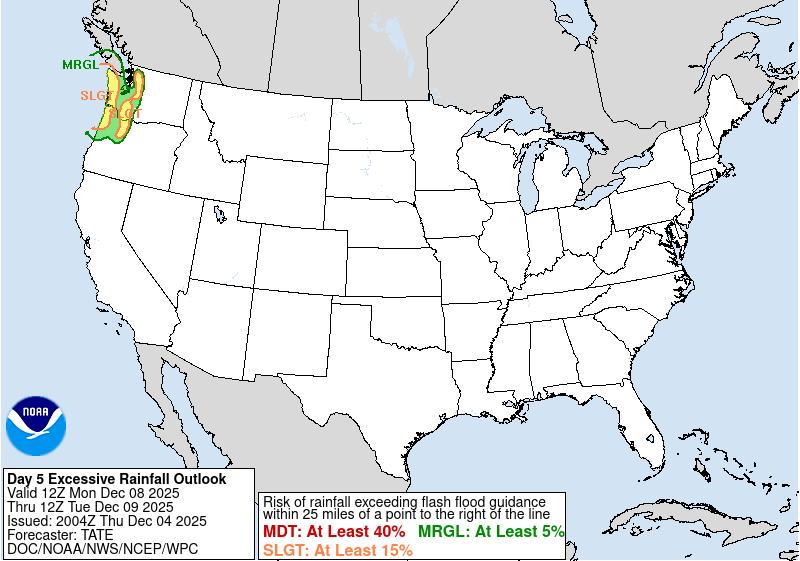
A series of atmospheric rivers (ARs) pounded the Pacific Northwest last week, resulting in catastrophic river flooding. The NWS Weather Prediction Center (WPC) seven-day Quantitative Precipitation Forecast (QPF) issued at 1022 UTC 04 December 2025 had rainfall amounts approaching 15 inches across the Coastal and Cascade Mountain ranges of Washington and Oregon. A Slight Risk for excessive rainfall was also introduced with the first issuance of the Excessive Rainfall Outlook (ERO), five days in advance of the first round of heavy rainfall on 08 December 2025.

NWS WPC 7-Day QPF
Figure 1: NWS WPC 7-Day QPF valid from 1200 UTC 04 December to 1200 UTC 11 December
NWS WPC Day 5 ERO
Figure 2: NWS WPC Day 5 ERO issued at 2004 UTC 04 December, valid for the 24-hour period ending at 1200 UTC 09 December 2025.

In viewing the GOES-West Full Disk Air Mass RGB imagery, the AR can be seen tracking from the Central Pacific on 07 December, before reaching the Pacific Northwest Coast on 08 December and persisting through 09 December. Waves of low pressure developed in an environment with high amounts of potential vorticity and tracked into Southwest Canada, maintaining the moist flow into WA & OR.

Figure 3: GOES-West Air Mass RGB imagery from 0000 UTC 07 December to 2350 UTC 09 December 2025. Credit: NESDIS/STAR

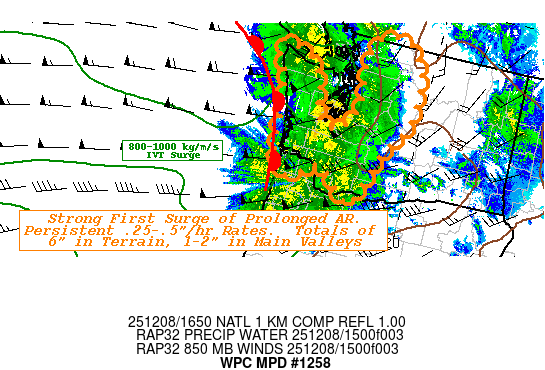
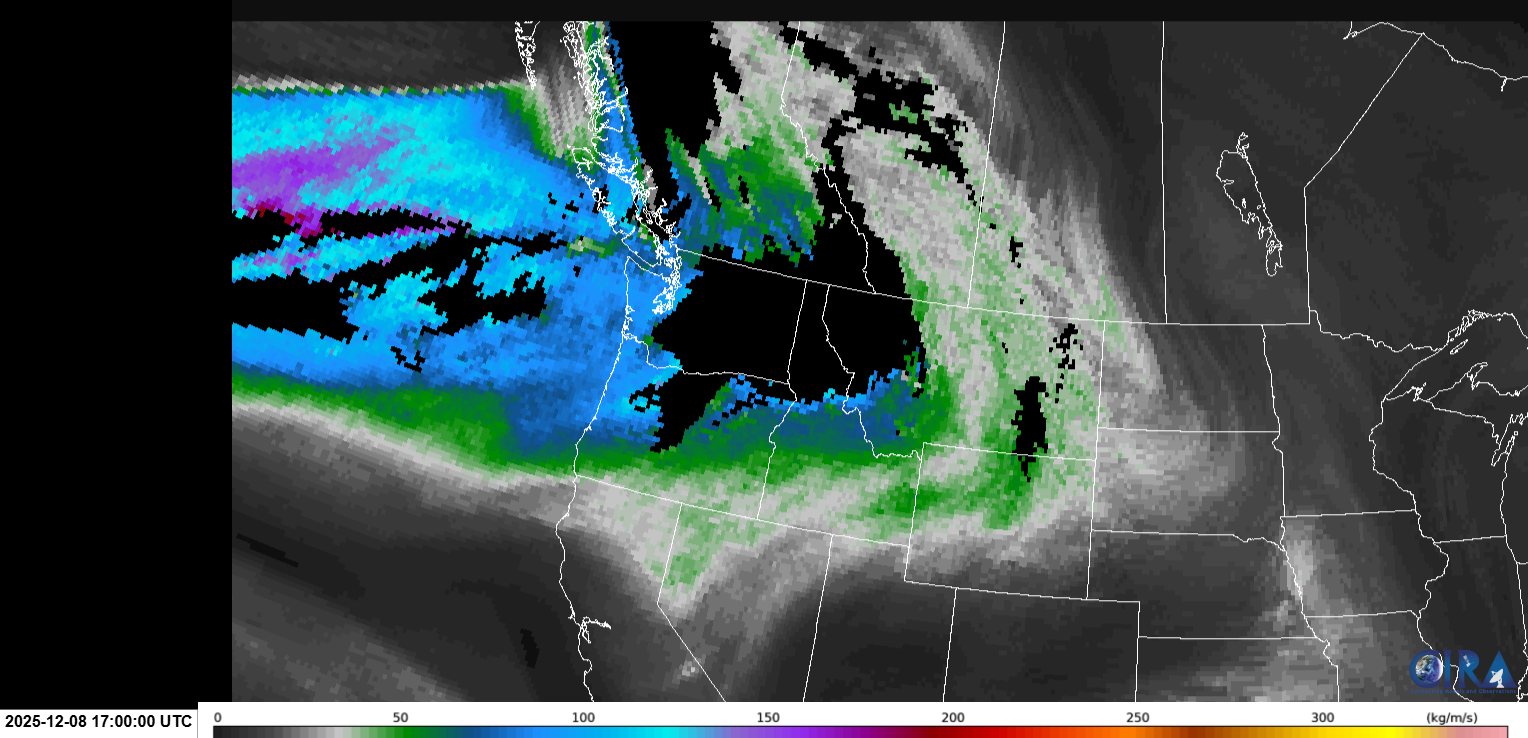
The WPC MetWatch Desk issued a Mesoscale Precipitation Discussion (MPD) at 1652 UTC 08 December 2025 for much of western WA, noting Integrated Vapor Transport (IVT) “values very near 1000 kg/m/s analyzed just offshore while remaining above 700 kg/m/s into the Cascades currently, but…expected to rise”. The CIRA Layered Vapor Transport (LVT) product also showed elevated moisture even at upper levels, with values exceeding 100 kg/m/s. The CIRA LVT product should be available in AWIPS at WPC in the next few months, and will have the same colorbar as IVT to allow for direct comparison. To note, WPC MPDs usually are in effect for six hours, but can extend out to 12 hours for ARs.

NWS WPC MPD
Figure 4: NWS WPC MPD issued at 1652 UTC 08 December, valid through 0400 UTC 09 December 2025.
CIRA LVT for the 500-300 hPa layer
Figure 5: CIRA LVT for the 500-300 hPa layer at 1700 UTC 08 December 2025. From CIRA Slider

December 8th was “round one” of the series of ARs. December 10th brought an additional strong AR, bringing heavy rains on already saturated soils and causing rivers to flood. The Advected Layered Precipitable Water (ALPW) product makes it easy to see the AR heading to the Pacific Northwest from the Tropical Pacific near Hawaii. At all layers, abundant moisture is observed rotating around the subtropical High Pressure system off the coast of Southern California.

ALPW from 0000 UTC 08 December
Figure 6: ALPW from 0000 UTC 08 December to 0400 UTC 11 December 2025. From CIRA

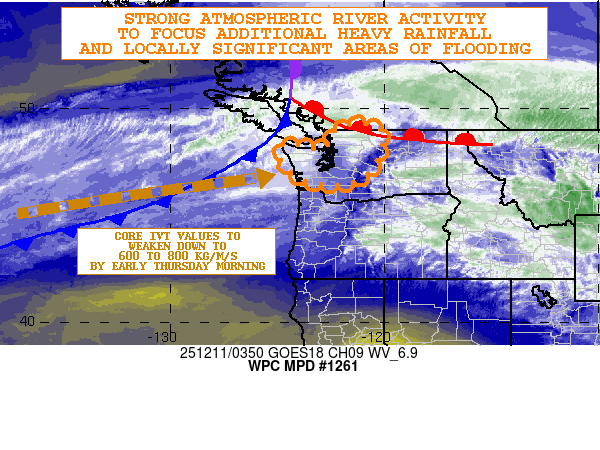
Multiple MPDs were issued through 10 & 11 December, including the one issued at 0407 UTC 11 December 2025 once again for western WA for “locally significant areal flooding, including potential for debris flows, landslides and localized flash flooding.”

NWS WPC MPD
Figure 7: NWS WPC MPD, overlaid on GOES-West Mid-Level Water Vapor Band 09 imagery, valid through 1530 UTC 11 December 2025.

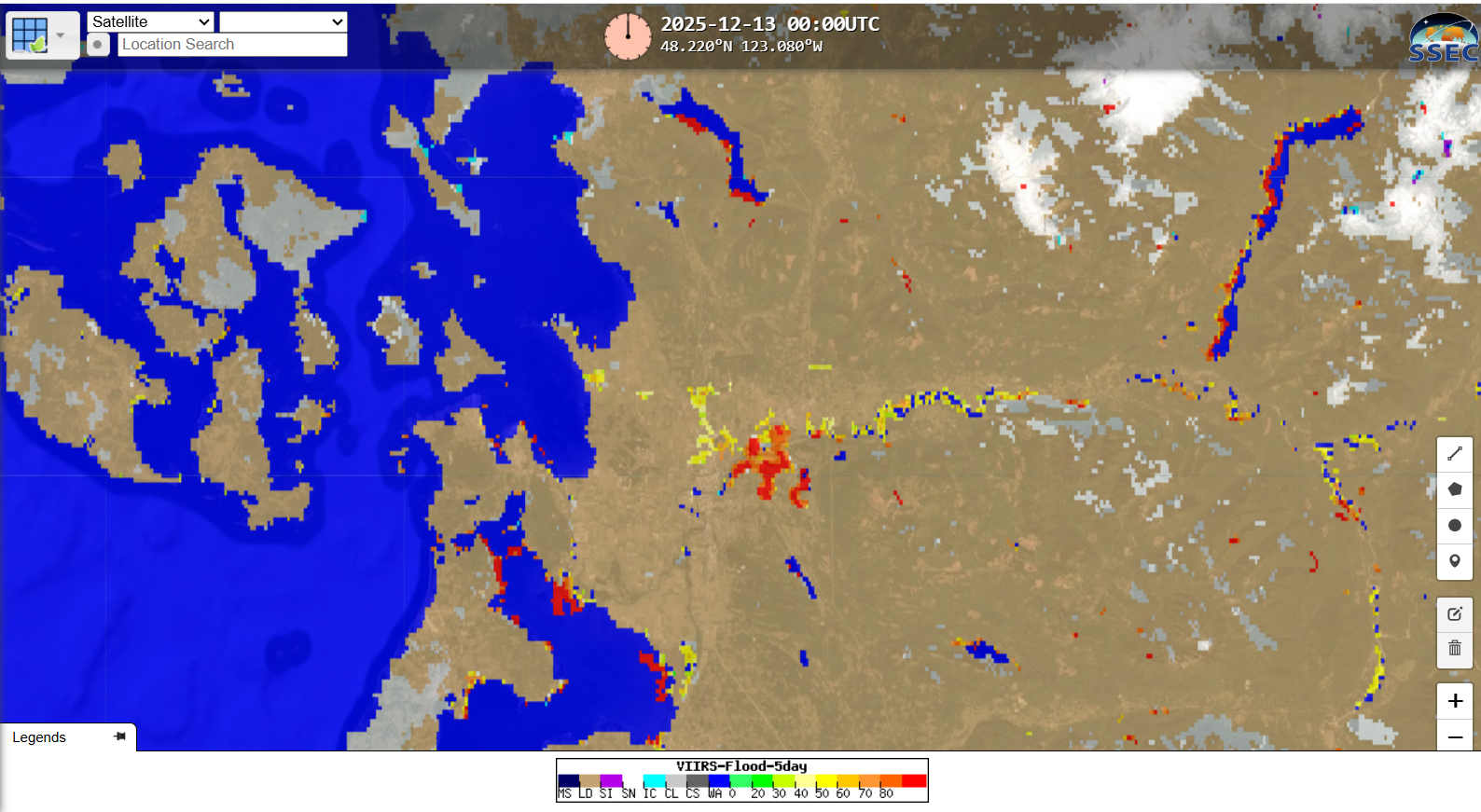
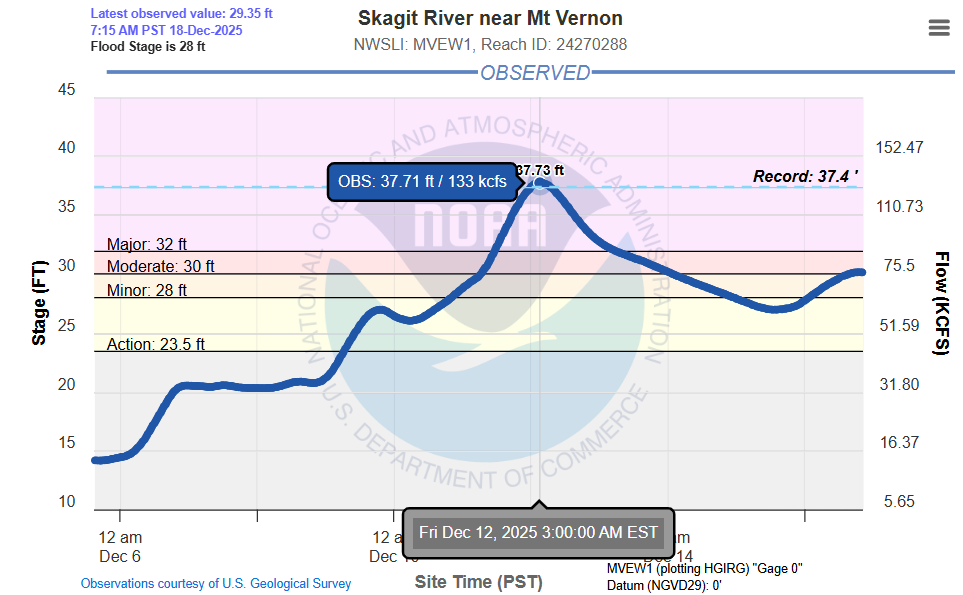
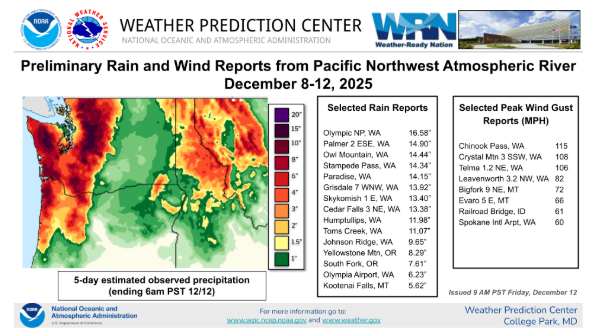
The CIMSS VIIRS 5-Day Flood Composite captured the flooding along the Skagit River near Burlington, WA, with over 90 percent of pixels showing floodwaters. Preliminarily, the gauage near Mt Vernon, WA, reached a record 37.7 feet, breaking the old record of 37.4 feet. Rainfall amounts across the higher elevations of western WA approached 15″ and wind gusts surpassed 100 mph.

VIIRS 5-Day Flood Composite
Figure 8: VIIRS 5-Day Flood Composite valid at 0000 UTC 13 December 2025. Source: SSEC RealEarth, UW-Madison
Gauge at Skagit River near Mt Vernon, WA
Figure 9: Gauge at Skagit River near Mt Vernon, WA. From NOAA/NWS National Water Prediction Service (NWPS) with observations courtesy of the U.S. Geological Survey.
NWS WPC Storm Summary
Figure 10: NWS WPC Storm Summary for the AR ending at 1400 UTC 12 December 2025.

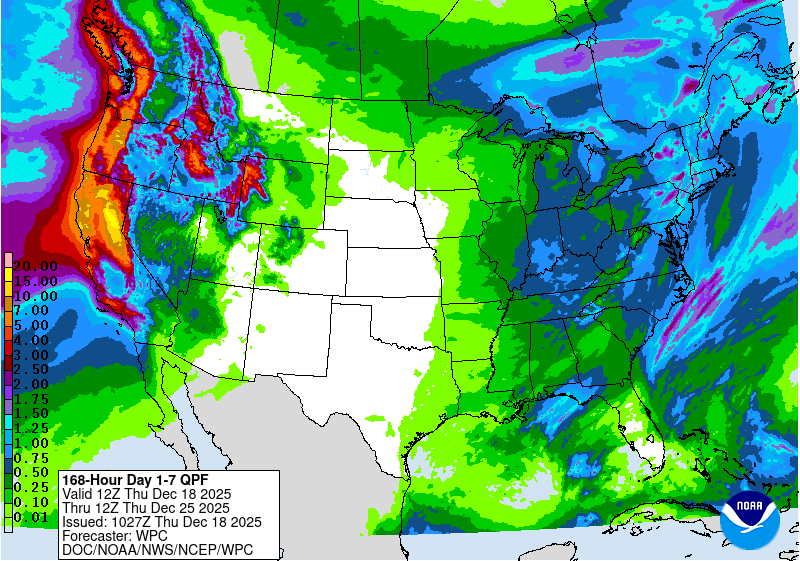
Additional ARs are expected to impact the West Coast over the next seven days, with areas further south in California also receiving heavy rainfall.

NWS WPC 7-day QPF
Figure 11: NWS WPC 7-day QPF issued at 1027 UTC 18 December 2025, valid from 1200 UTC 18 December to 1200 UTC 25 December 2025.
Picture of Christopher Smith

Christopher Smith

Christopher Smith joined ESSIC/CISESS, University of Maryland in 2023 and is the GOES-R Satellite Liaison for the NWS Weather and Ocean Prediction Centers. Smith works to interpret experimental satellite imagery and products, and make such products available to forecasters and the NWS for a route to operations. He trains forecasters how to use satellite imagery in weather forecasting, while also delivering forecaster feedback to satellite developers to maximize meteorological satellite capabilities. Smith is an alumni of the UMD Atmospheric & Oceanic Science (AOSC) Department, and his long-term interests include infusing AI-Satellite Products to increase lead time in decision making for forecasters.