Early Career Scientist Spotlight: Cheng Da
Post-doctoral associate Dr. Cheng Da was recently featured in a NASA Early Career Scientist Spotlight.

Post-doctoral associate Dr. Cheng Da was recently featured in a NASA Early Career Scientist Spotlight.

ESSIC/CISESS Scientist Qingyuan Zhang has published a paper entitled “Impacts of abiotic and biotic factors on tundra productivity near Utqiaġvik, Alaska” in Environmental Research Letters.

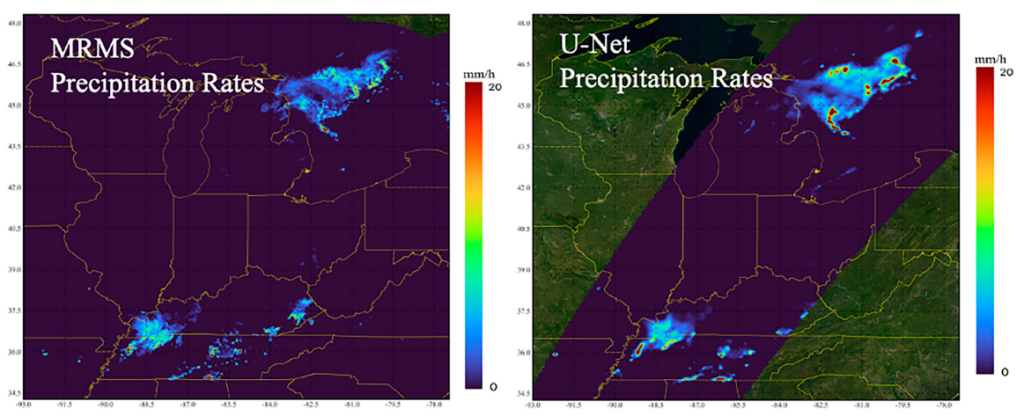
Veljko Petković is first author on a new paper in Journal of Applied Meteorology and Climatology titled, “Can We Estimate the Uncertainty Level of Satellite Long-Term Precipitation Records?”.

1.2 billion people around the world rely on seasonal snow for their water supply. However, no snow-focused satellite currently exists. The satellites that do attempt to look at the spatial coverage and temperature of snow often struggle to retrieve information about snow in forested regions, which accounts for nearly half of Earth’s snow cover. The forest canopy blocks a lot of satellite remote sensing retrievals, forcing scientists to rely on models. However, processes that control how snow accumulates and melts are pretty different in forested and exposed locations. For example, warmer forests like in the US Pacific Northwest have larger amounts of snow intercepted by the forest canopy and winter snowmelt. This typically makes snow last longer in clearings than in the forest. The opposite is true in colder climates, where snow tends to last longer in the forest.

Last week, NASA held its annual meeting of the Precipitation Measurement Mission (PMM) Science Team at the University of Minnesota. The team consists of approximately 40 principal investigators and several other co-investigators. ESSIC has eight scientists involved in this capacity. The PMM scientists present the current status of their projects that are centered around the Global Precipitation Measurement (GPM) mission and its constellation of other satellites.

ESSIC/CISESS Visiting Associate Research Scientist David S. Trossman is co-author on a new paper in Global Biogeochemical Cycles titled “Respiration Patterns in the Dark Ocean”.

Last week, the Grand Challenges team, led by ESSIC Director Ellen Williams, met with Matt Fleming, Executive Director of the Resilience Authority of Annapolis and Anne Arundel County, to begin a partnership to better understand the climate and environmental issues and priorities of Anne Arundel county and the city of Annapolis.

ESSIC Assistant Research Scientist Weston Anderson was recently featured in NASA’s Sciences and Exploration Directorate Early Career Scientist Spotlight.

This month, the 2023 Global Precipitation Measurement Mission (GPM) Mentorship program comes to an end. The project, coordinated by ESSIC Assistant Research Scientist Lisa Milani with the help of colleagues Andrea Portier and Vaso Mantas, involved ten Italian teachers from four different schools. The effort included three lectures about “the Water Cycle”, “Weather and Climate” and “GPM products and applications” and targeted middle- and high-school teachers aiming to apply outreach material in the classroom context. After the three lectures, the teachers involved their students in a practical project applying language, programming and science contents and skills.

ESSIC Research Scientist Sampa Das has been selected as a recipient of the 2023 Robert H. Goddard Honor Award, NASA’s Center-level award selected annually by an awards committee based on the nominations from the peers. Das received an award under the category of “Excellence in Science”. She is one of the 9 individuals selected for 2023 across the Sciences and Exploration Directorate.