
Can We Use Future Observations to Improve Current Forecasts without Cheating?
This event has passed. See the seminar recording here:
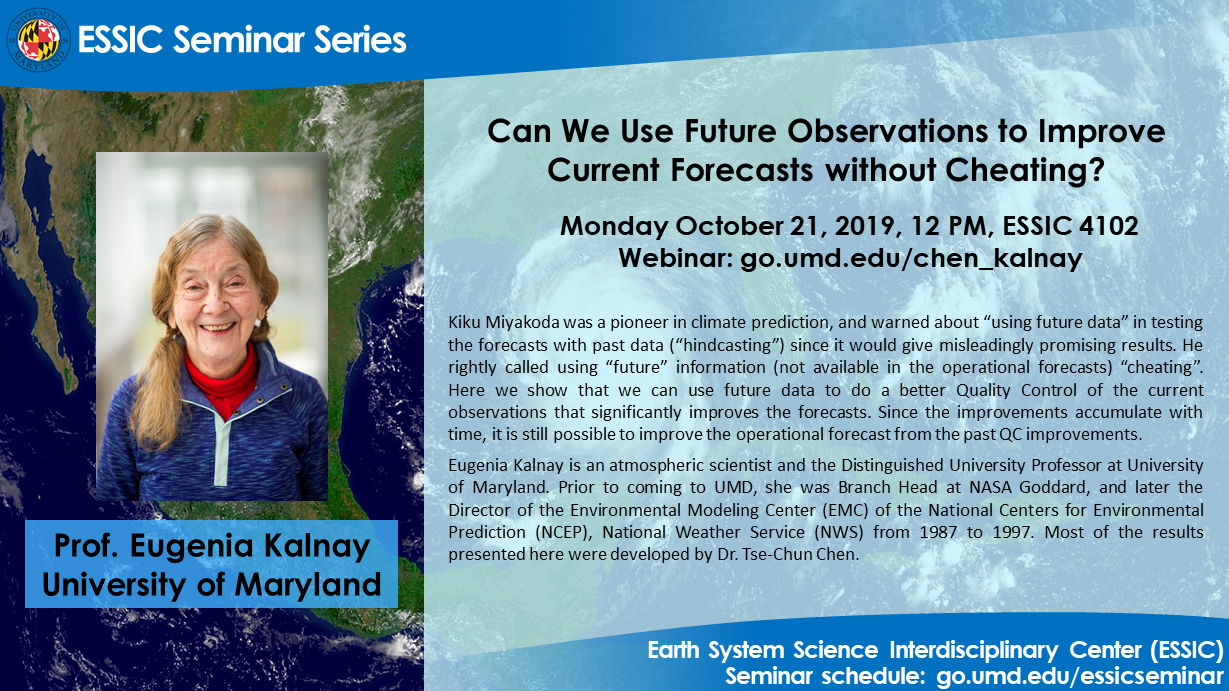
Tse-Chun Chen, Eugenia Kalnay
University of Maryland
Monday October 21, 2019, 12 PM
ESSIC Conference Room 4102, 5825 University Research Ct, College Park, MD 20740
Abstract:
Kiku Miyakoda was a pioneer in climate prediction, and warned about “using future data” in testing the forecasts with past data (“hindcasting”) since it would give misleadingly promising results. He rightly called using “future” information (not available in the operational forecasts) “cheating”. Here we show that we can use future data to do a better Quality Control of the current observations that significantly improves the forecasts. Since the improvements accumulate with time, it is still possible to improve the operational forecast from the past QC improvements.
Bio-sketch:
Eugenia Kalnay is an atmospheric scientist and the Distinguished University Professor at University of Maryland. Prior to coming to UMD, Eugenia Kalnay was Branch Head at NASA Goddard, and later the Director of the Environmental Modeling Center (EMC) of the National Centers for Environmental Prediction (NCEP, formerly NMC), National Weather Service (NWS) from 1987 to 1997. During those ten years there were major improvements in the NWS models’ forecast skill. Many successful projects such as the 60+years NCEP/NCAR Reanalysis (the paper on this Reanalysis has been cited over 10,000 times), seasonal and interannual dynamical predictions, the first operational ensemble forecasting, 3-D and 4-D variational data assimilation, advanced quality control, and coastal ocean forecasting. EMC became a pioneer in both the fundamental science and the practical applications of numerical weather prediction.
Current research interests of Dr. Kalnay are in numerical weather prediction, data assimilation, predictability and ensemble forecasting, coupled ocean-atmosphere modeling and climate change and sustainability. Zoltan Toth and Eugenia Kalnay introduced the breeding method for ensemble forecasting. She is also the author (with Ross Hoffman and Wesley Ebisuzaki) of other widely used ensemble methods known as Lagged Averaged Forecasting and Scaled LAF. Her book, Atmospheric Modeling, Data Assimilation and Predictability (Cambridge University Press, 2003) sold out within a year, is now on its fifth printing and was published in Chinese (2005) and in Korean (2012). A second edition is in preparation. She has received numerous awards, including the 2009 IMO Prize of the World Meteorological Organization, and is a member of the UN Scientific Advisory Board (2013), the NOAA Scientific Advisory Board (2016) and other Scientific Boards.
Webinar info:
Event site: http://go.umd.edu/chen_kalnay
Event number: 730 110 175
Event password: essic
——————————————————-
To join the online event
——————————————————-
1. Click here to join the online event.
Or copy and paste the following link to a browser:
https://umd.webex.com/umd/onstage/g.php?MTID=eb22e76b74316451f1b15cd1e566f58ea
2. Click “Join Now”.
——————————————————-
To join the audio conference only
——————————————————-
US Toll: +1-415-655-0002
Global call-in numbers:
https://umd.webex.com/umd/globalcallin.php?MTID=e22b40d6723d6aa51792af469ea383a81
Access code: 730 110 175
——————————————————-
For IT assistance
——————————————————-
Cazzy Medley: cazzy@umd.edu
Travis Swaim: tswaim1@umd.edu
Follow ESSIC:
ESSIC homepage: http://essic.umd.edu/
ESSIC seminar schedule/archive: https://go.umd.edu/essicseminar
ESSIC seminar site: https://go.umd.edu/essicseminarsite
ESSIC Youtube: https://www.youtube.com/user/ESSICUMD
ESSIC Twitter: https://twitter.com/ESSICUMD
ESSIC Facebook: https://facebook.com/ESSICUMDs
ESSIC seminar coordinator: Dr. John Yang, jxyang@umd.edu
Contact coordinator for subscribing email announcement or giving a talk