

The Complexity of Upper Tropospheric and Lower Stratospheric Aerosols
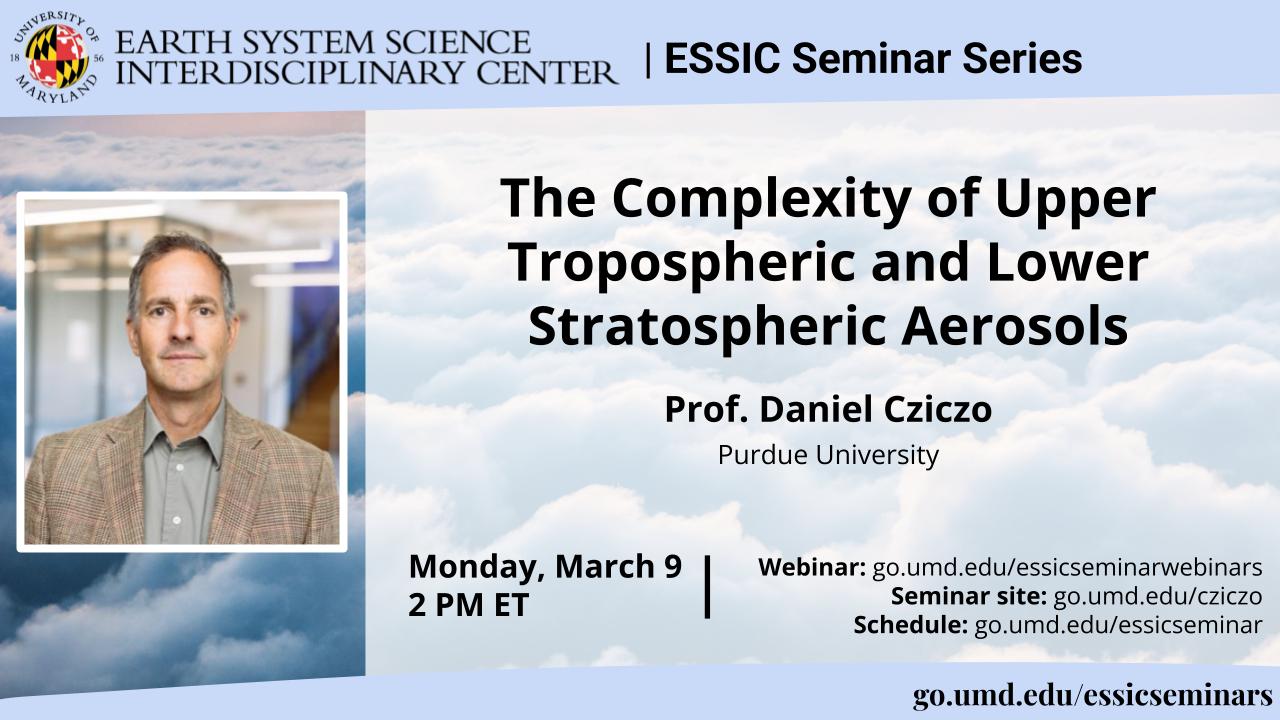
Prof. Daniel Cziczo
Purdue University
Monday March 9, 2026, 2 PM ET
Abstract:
The composition of particles found in the upper tropospheric / lower stratospheric (UTLS) has now been studied in situ and in real time for a quarter century. First deployed in 1998, NOAA’s Particle Analysis by Laser Mass Spectrometry (PALMS) instrument showed the complex internal and external mixing state of aerosols in this region of the atmosphere. Developed jointly by NOAA and Purdue, the PALMS-Next Generation (-NG) instrument has expanded on these measurements. Using data from these instruments, our group was able to show unexpected complexity in the LS aerosol. Biomass burning particles, sourced from the troposphere and likely entrained in convection, were found up to 4 km above the local tropopause. Meteoric smoke particles, sedimented from the mesosphere and internally mixed with sulfuric acid, were often found to also contain materials from spacecraft ablation. These two particle types were also often found to be internally mixed, indicative of coagulation processes in the LS. This presentation will first describe these observations and then discuss how this unexpected complexity impacts our climate, precipitation and atmospheric chemistry.
Biosketch:
Dan Cziczo is Professor in the Department of Earth, Atmospheric and Planetary Sciences (EAPS) and the School of Aeronautics and Astronautics at Purdue University. He is an atmospheric scientist interested in the interrelationship of particulate matter and cloud formation. His research utilizes laboratory and field studies to elucidate how small particles interact with water vapor to form droplets and ice crystals which are important players in the Earth’s climate system. His group uses small cloud chambers in the laboratory to mimic atmospheric conditions that lead to cloud formation and observing clouds in situ from remote mountaintop sites or through the use of research aircraft. Dan’s current research interests include the chemical composition of atmospheric aerosols, Earth’s radiative budget, and meteoritic, spacecraft debris and launch vehicle emissions in the atmosphere.
Zoom Information
Zoom Webinar: https://go.umd.edu/essicseminarwebinars
Zoom Meeting ID: 918 7733 3086
Zoom password: essic
US Toll: +13017158592
Global call-in numbers: https://umd.zoom.us/u/aMElEpvNu
Resources:
Seminar schedule & archive: https://go.umd.edu/essicseminar
Seminar Google calendar: https://go.umd.edu/essicseminarcalendar
Seminar recordings on Youtube: https://www.youtube.com/user/ESSICUMD