
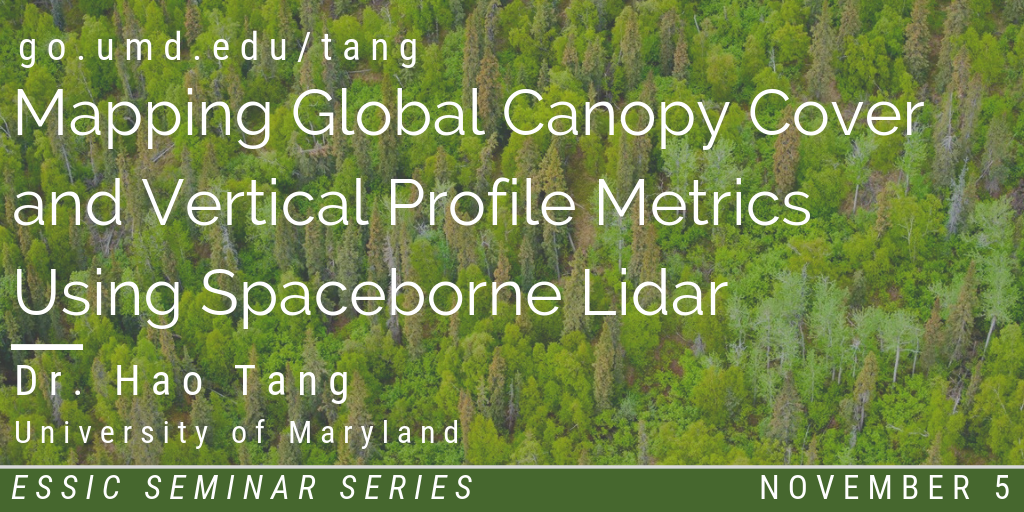
Mapping global canopy cover and vertical profile metrics using Spaceborne Lidar
This event has passed. See the seminar recording here:
Dr. Hao Tang
University of Maryland
Monday November 5, 2018, 12:00-1:00 PM
ESSIC Conference Room 4102, 5825 University Research Ct, College Park, MD 20740
Abstract:
Detailed estimates of global forest carbon stocks and dynamics require accurate measurements of vertical canopy structure. Passive optical remote sensing techniques cannot fully meet this observation requirement due to technical limitations and large algorithm uncertainties. Spaceborne lidar remote sensing can fill this gap in contemporary Earth observation networks by providing direct measurements of 3-D canopy structure. This seminar will discuss our most recent research and development in mapping global forest structure using spaceborne lidar instruments.
In the first part, we analyze global canopy cover and vertical leaf area index (LAI) profile distributions derived using observations from the decommissioned Geoscience Laser Altimetry System (GLAS) onboard of NASA’s Ice, Cloud, and land Elevation Satellite (ICESat-1). We conclude that spaceborn lidar can more precisely characterize the biome-level gradient and distribution of canopy structure particular over densely covered forests. In the second part, we discuss the development status of an equivalent data set of canopy cover and LAI profile that will be made available from NASA’s upcoming Global Ecosystem Dynamics Investigation (GEDI) mission. Improvement in GEDI data products should allow more comprehensive analysis of subtle canopy structure changes in global forests caused by either human or natural disturbance agents, and provide unique information for biophysical stratification of forests and changes in vertical canopy structure.
Bio-sketch:
Dr. Hao Tang is an Assistant Research Professor in the Department of Geographical Sciences at University of Maryland College Park, where he also received his PhD degree in 2015. His research interests focus on characterizing 3D dynamics of terrestrial ecosystems using different lidar remote sensing platforms. He is currently working on NASA’s Global Ecosystem Dynamics Investigation (GEDI) mission as a member of the Science Definition Team. He is a recipient of NASA Earth and Space Science fellowship and NASA New Investigator Award.
Webex info:
Event number: 738 786 729
Event password: essic
——————————————————-
To join the online event
——————————————————-
1. Click here to join the online event.
Or copy and paste the following link to a browser:
https://umd.webex.com/umd/onstage/g.php?MTID=ec8a71d6b088dc1fa5e1421965d47959a
2. Click “Join Now”.
——————————————————-
To join the audio conference only
——————————————————-
US Toll: +1-415-655-0002
Global call-in numbers: https://umd.webex.com/umd/globalcallin.php?serviceType=EC&ED=686491087&tollFree=0
Access code: 738 786 729
——————————————————-
For IT assistance
——————————————————-
Contact Travis Swaim at: tswaim1@umd.edu
Follow ESSIC:
ESSIC homepage: http://essic.umd.edu/
ESSIC seminar calendar: MSQ-4102; http://go.umd.edu/essicseminar
ESSIC twitter: http://twitter.com/ESSICUMD
ESSIC facebook: http://facebook.com/ESSICUMD
ESSIC seminar coordinator: Dr. John Yang, jxyang@umd.edu