
Overview of JMA’s Himawari Satellites and Validation of NOAA’s GLM Product
This event has passed. See the seminar recording here:
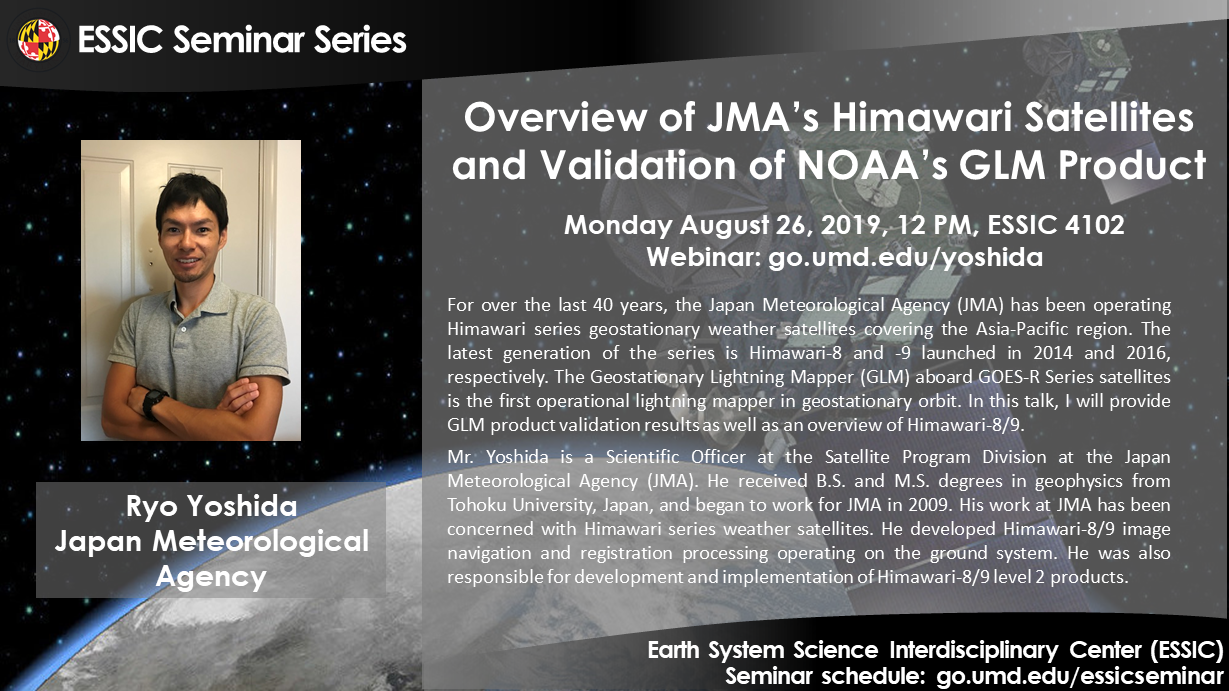
Ryo Yoshida
Japan Meteorological Agency
Monday August 26, 2019, 12 PM
ESSIC Conference Room 4102, 5825 University Research Ct, College Park, MD 20740
Abstract:
For over the last 40 years, the Japan Meteorological Agency (JMA) has been operating Himawari series geostationary weather satellites covering the Asia-Pacific region. The latest generation of the series is Himawari-8 and -9 launched in 2014 and 2016, respectively. Equipped with the Advanced Himawari Imager, Himawari-8/9 enhances JMA’s weather monitoring and prediction. Himawari-8/9 data are distributed internationally to national meteorological and hydrological services, and the data are also open to academic and nonprofit users.
JMA has undertaken feasibility studies of Himawari-8/9 follow-on satellites. Lightning mappers on geostationary satellites are expected to provide continuous total (intra-cloud and cloud-to-ground) lightning observation. The Geostationary Lightning Mapper (GLM) aboard GOES-R Series satellites is the first operational lightning mapper in geostationary orbit. To assess the GLM performance, this study validates the GOES-16 GLM level 2 product, using ground-based lightning observation data. In this talk, I will provide the GLM product validation results as well as an overview of Himawari-8/9.
Bio-sketch:
Mr. Yoshida is a Scientific Officer at the Satellite Program Division at the Japan Meteorological Agency (JMA). He received B.S. and M.S. degrees in geophysics from Tohoku University, Japan, and began to work for JMA in 2009. His work at JMA has been concerned with Himawari series weather satellites. He developed Himawari-8/9 image navigation and registration processing operating on the ground system. He was also responsible for development and implementation of Himawari-8/9 level 2 products. Since November 2018, he has been a 1-year visiting scientist at ESSIC to research NOAA’s advanced efforts for weather satellites including the Geostationary Lightning Mapper.
Webinar info:
Event site: http://go.umd.edu/yoshida
Event number: 733 226 651
Event password: essic
——————————————————-
To join the online event
——————————————————-
1. Click here to join the online event.
Or copy and paste the following link to a browser:
https://umd.webex.com/umd/onstage/g.php?MTID=e487f5a7f53f7ae19638a77de09209ce2
2. Click “Join Now”.
——————————————————-
To join the audio conference only
——————————————————-
US Toll: +1-415-655-0002
Global call-in numbers:
https://umd.webex.com/umd/globalcallin.php?MTID=e6a780a8049dbf3da0f8745ec4b471098
Access code: 733 226 651
——————————————————-
For IT assistance
——————————————————-
Cazzy Medley: cazzy@umd.edu
Travis Swaim: tswaim1@umd.edu
Follow ESSIC:
ESSIC homepage: http://essic.umd.edu/
ESSIC seminar schedule/archive: http://go.umd.edu/essicseminar
ESSIC seminar site: http://go.umd.edu/essicseminarsite
ESSIC Youtube: http://www.youtube.com/user/ESSICUMD
ESSIC Twitter: http://twitter.com/ESSICUMD
ESSIC Facebook: http://facebook.com/ESSICUMD
ESSIC seminar coordinator: Dr. John Yang, jxyang@umd.edu
Contact the coordinator for subscribing email announcement or giving a talk