
Representation of Spring Season Antarctic Boundary Layer and Polar Lows in the NASA Global Modeling Framework
This event has passed. See the seminar recording here:
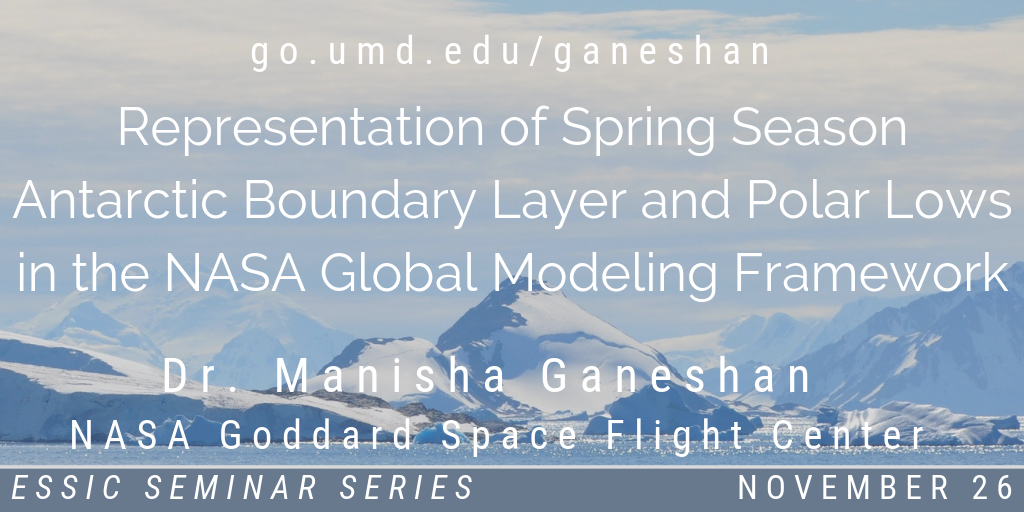
Dr. Manisha Ganeshan
NASA Goddard Space Flight Center
Monday November 26, 2018, 12:00-1:00 PM
ESSIC Conference Room 4102, 5825 University Research Ct, College Park, MD 20740
Abstract:
Studies have shown that the Antarctic boundary layer is mostly stable with a surface-based inversion (SBI) present all year round except during summer when the incoming shortwave forcing is maximum. High-resolution dropsonde observations from the 2010 Concordiasi field campaign in austral spring, reveal that wind-driven turbulence can erode SBIs leading to well-mixed boundary layers which occur as frequently as 33% and 18% in West and East Antarctica, respectively. Knowledge of the Antarctic atmospheric boundary layer structure is critical for modeling the local energy budget and surface mass balance. In this early report, the regional representation of the Antarctic boundary layer temperature structure in the Modern-Era Retrospective analysis for Research and Applications, Version 2 (MERRA2) is compared against the dropsonde measurements from the Concordiasi campaign. The working of the turbulent scheme in the Goddard Earth Observing System Model, Version 5 (GEOS-5), is evaluated in context to the biases.
In the second part of this talk, the representation of polar mesoscale cyclones, namely Antarctic polar lows, is investigated in high-resolution (quarter degree) GEOS5 analysis. Polar lows are convectively driven, warm-core, mesoscale cyclones that form over the ice-free ocean in the poleward side of the jet stream. They are most common during the spring and winter seasons when turbulent heat flux exchange is favored between the cold atmosphere and warmer ice-free ocean. Due to their rapid growth at sub-synoptic scales in regions with very few traditional observations, prediction of polar lows remains a challenge for Numerical Weather Prediction. Here, occurrences of Antarctic polar lows during the austral spring season are investigated with Observing System Experiments (OSEs) performed using the GEOS5 model at quarter degree resolution to evaluate the impact of assimilating cloud-cleared against clear-sky radiances from the AIRS (Atmospheric Infrared Sounder) instrument.
Bio-sketch:
Dr. Ganeshan is a researcher at NASA Goddard Space Flight Center. Her research includes studying the atmospheric boundary layer and turbulent mixing processes in polar regions using in-situ observations. In addition, she uses remote sensing measurements from GPS RO, CALIPSO, MODIS, and AIRS instruments for polar atmospheric research. Dr. Ganeshan is interested in improving the physical representation of sub-grid scale turbulent processes in climate models based on guidance from satellite and in-situ observations. Dr. Ganeshan contributes to research in the Global Modeling and Data Assimilation (GMAO) office at Goddard, where she investigates the impact of different assimilation experiments on the representation of high-latitude weather and storms. She is a 2017 Fellow of the International Arctic Science Committee (IASC), and is involved in the scientific activities of the Atmospheric Working group.
Webex info:
Event number: 733 990 222
Event password: essic
——————————————————-
To join the online event
——————————————————-
1. Click here to join the online event.
Or copy and paste the following link to a browser:
https://umd.webex.com/umd/onstage/g.php?MTID=eb6b3113743c12b52404a140b8ee8b990
2. Click “Join Now”.
——————————————————-
To join the audio conference only
——————————————————-
US Toll: +1-415-655-0002
Global call-in numbers: https://umd.webex.com/umd/globalcallin.php?serviceType=EC&ED=689589732&tollFree=0
Access code: 733 990 222
——————————————————-
For IT assistance
——————————————————-
Contact Travis Swaim at: tswaim1@umd.edu
Follow ESSIC:
ESSIC homepage: http://essic.umd.edu/
ESSIC seminar calendar: MSQ-4102; http://go.umd.edu/essicseminar
ESSIC twitter: http://twitter.com/ESSICUMD
ESSIC facebook: http://facebook.com/ESSICUMD
ESSIC seminar coordinator: Dr. John Yang, jxyang@umd.edu