
Retrieving Cloud Microphysical Properties from Passive Shortwave Remote Sensing: Lessons about the Impact of Cloud Inhomogeneity from Simulators, and Observations
This event has passed. See the seminar recording here:
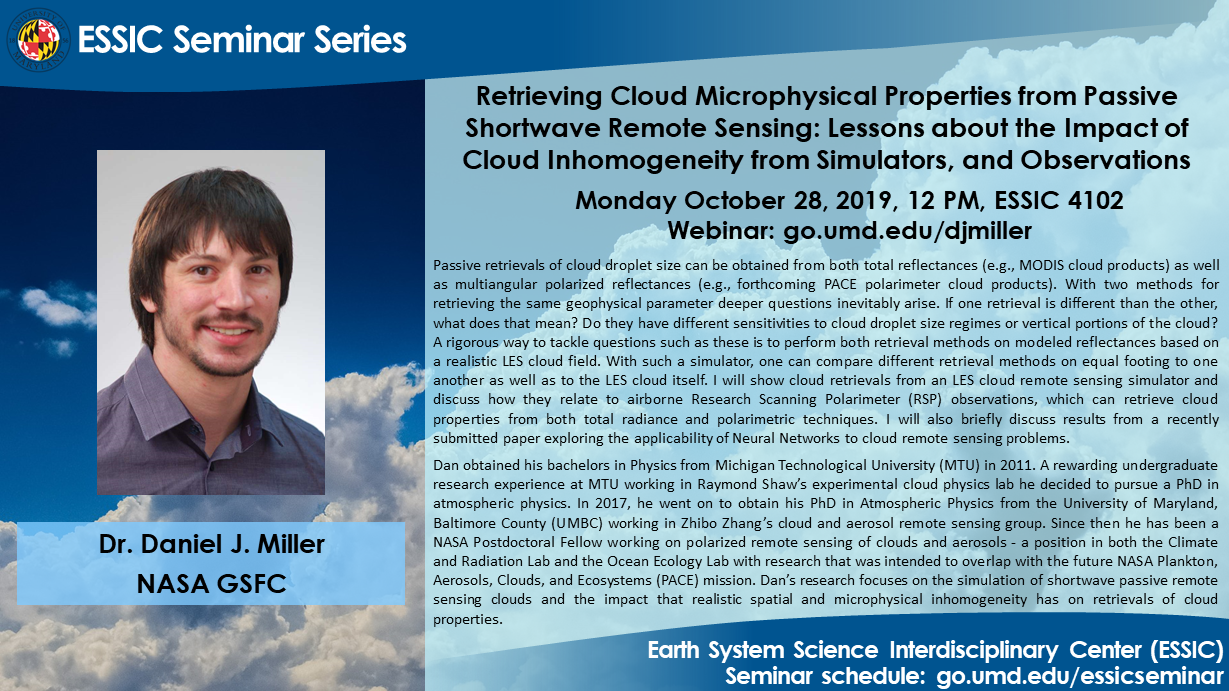
Dr. Daniel J. Miller
NASA Goddard Space Flight Center
Monday October 28, 2019, 12 PM
ESSIC Conference Room 4102, 5825 University Research Ct, College Park, MD 20740
Abstract:
Passive retrievals of cloud droplet size can be obtained from both total reflectances (e.g., MODIS cloud products) as well as multiangular polarized reflectances (e.g., forthcoming PACE polarimeter cloud products). With two methods for retrieving the same geophysical parameter deeper questions inevitably arise. If one retrieval is different than the other, what does that mean? Do they have different sensitivities to cloud droplet size regimes or vertical portions of the cloud? A rigorous way to tackle questions such as these is to perform both retrieval methods on modeled reflectances based on a realistic LES cloud field. With such a simulator, one can compare different retrieval methods on equal footing to one another as well as to the LES cloud itself. I will show cloud retrievals from an LES cloud remote sensing simulator and discuss how they relate to airborne Research Scanning Polarimeter (RSP) observations, which can retrieve cloud properties from both total radiance and polarimetric techniques. I will also briefly discuss results from a recently submitted paper exploring the applicability of Neural Networks to cloud remote sensing problems.
Bio-sketch:
Dan obtained his bachelors in Physics from Michigan Technological University (MTU) in 2011. A rewarding undergraduate research experience at MTU working in Raymond Shaw’s experimental cloud physics lab he decided to pursue a PhD in atmospheric physics. In 2017, he went on to obtain his PhD in Atmospheric Physics from the University of Maryland, Baltimore County (UMBC) working in Zhibo Zhang’s cloud and aerosol remote sensing group. Since then he has been a NASA Postdoctoral Fellow working on polarized remote sensing of clouds and aerosols – a position in both the Climate and Radiation Lab and the Ocean Ecology Lab with research that was intended to overlap with the future NASA Plankton, Aerosols, Clouds, and Ecosystems (PACE) mission. Dan’s research focuses on the simulation of shortwave passive remote sensing clouds and the impact that realistic spatial and microphysical inhomogeneity has on retrievals of cloud properties.
Webinar info:
Event site: http://go.umd.edu/djmiller
Event number: 735 535 861
Event password: essic
——————————————————-
To join the online event
——————————————————-
1. Click here to join the online event.
2. Click “Join Now”.
——————————————————-
To join the audio conference only
——————————————————-
US Toll: +1-415-655-0002
Global call-in numbers:
https://umd.webex.com/umd/globalcallin.php?MTID=e4917e00da414caf331216055351c37f9
Access code: 735 535 861
——————————————————-
For IT assistance
——————————————————-
Cazzy Medley: cazzy@umd.edu
Travis Swaim: tswaim1@umd.edu
Follow ESSIC:
ESSIC homepage: http://essic.umd.edu/
ESSIC seminar schedule/archive: https://go.umd.edu/essicseminar
ESSIC seminar site: https://go.umd.edu/essicseminarsite
ESSIC Youtube: https://www.youtube.com/user/ESSICUMD
ESSIC Twitter: https://twitter.com/ESSICUMD
ESSIC Facebook: https://facebook.com/ESSICUMDs
ESSIC seminar coordinator: Dr. John Yang, jxyang@umd.edu
Contact coordinator for subscribing email announcement or giving a talk