
Physical Constraints and Future Projections of Midlatitude Moist Heat Extremes
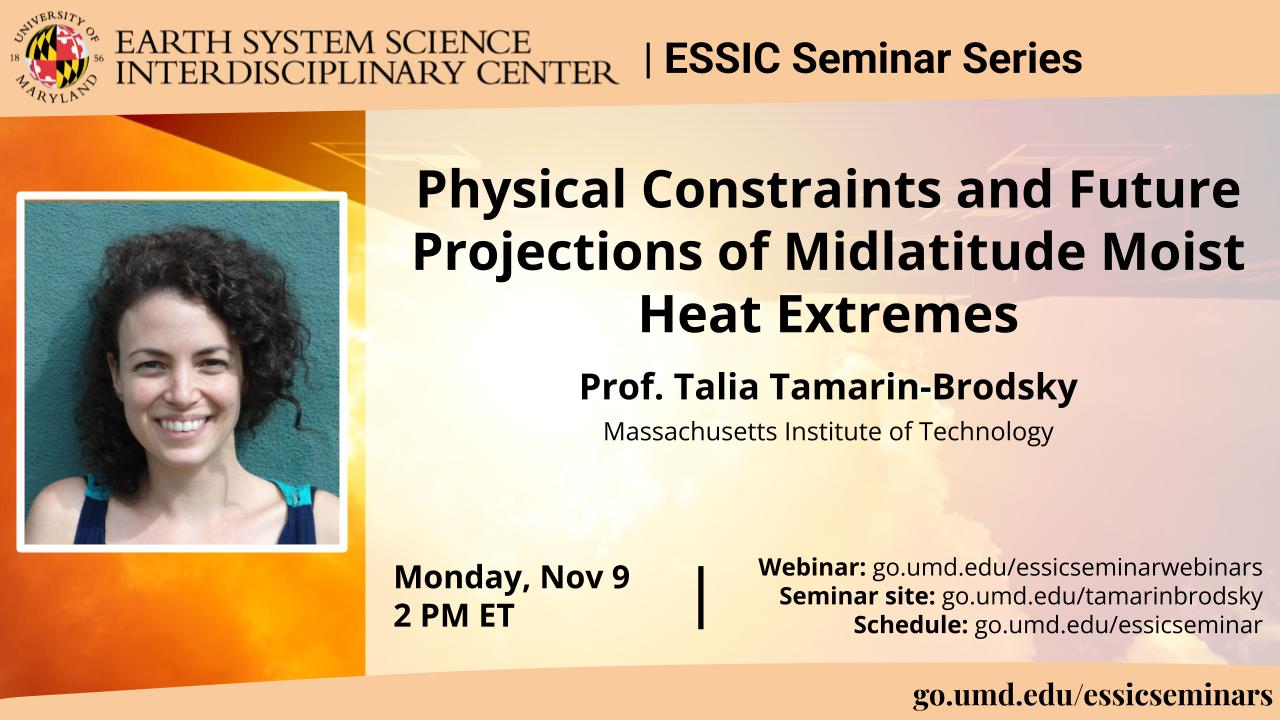
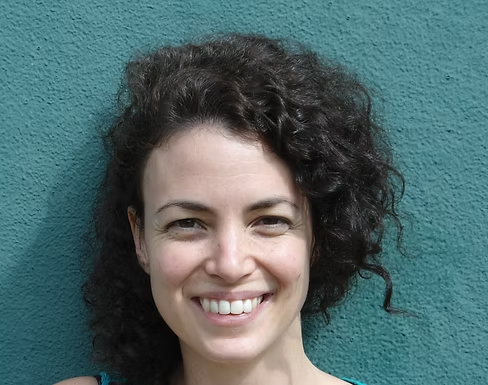
Prof. Talia Tamarin-Brodsky
Massachusetts Institute of Technology
Monday November 9, 2026, 2 PM ET
Abstract:
Extreme near-surface moist heat and severe convective storms are among the leading causes of weather-related damages worldwide. Episodes of extreme moist heat and severe convection frequently co-occur across midlatitude land regions, yet the processes that constrain their maximum intensities remain poorly understood. Here, a theoretical framework is developed that links their maximum intensities to preexisting low-level energy inversions in the atmosphere. By accounting for the stored-energy nature of midlatitude severe convection, in which near-surface moist heat and atmospheric instability accumulate before convection initiates, this framework identifies low-level inversions as a critical factor shaping compound extreme heat and convective weather risks. Under climate change, these moist weather extremes are projected to intensify substantially in the midlatitudes, particularly downstream of major highland terrains. This intensification is tightly constrained by changes in low-level atmospheric inversions: amplified warming over western highlands is transported downstream by prevailing westerlies, strengthening inversions and raising the attainable maxima of moist heat and convection. These results highlight low-level inversions as a key regulator of midlatitude moist weather extremes and their response to climate change.
Biosketch:
Talia Tamarin-Brodsky is Assistant Professor of Atmospheric Sciences and the Class of 1947 Career Development Professor in the Department of Earth, Atmospheric and Planetary Sciences at the Massachusetts Institute of Technology. Her research focuses on atmospheric dynamics at the interface of weather and climate, including midlatitude storm tracks, Rossby-wave breaking, circulation persistence, temperature variability, and regional weather and climate extremes. Her group combines theory, observations, computation, and model simulations to develop physically based frameworks that connect individual weather systems to large-scale circulation and climate statistics, and to understand how these relationships will change in a warming climate. She received her PhD in Earth and Planetary Sciences from the Weizmann Institute of Science and was previously a James S. McDonnell Foundation Postdoctoral Fellow at the University of Reading, UK. She currently serves as co-chair of the American Meteorological Society’s Committee on Atmospheric and Oceanic Fluid Dynamics.
Zoom Information
Event site: https://go.umd.edu/tamarinbrodsky
Zoom Webinar: https://go.umd.edu/essicseminarwebinars
Zoom Meeting ID: 971 2692 9944
Zoom password: essic
US Toll: 13017158592
Global call-in numbers: https://umd.zoom.us/u/aMElEpvNu
Resources:
Seminar schedule & archive: https://go.umd.edu/essicseminar
Seminar Google calendar: https://go.umd.edu/essicseminarcalendar
Seminar recordings on Youtube: https://www.youtube.com/user/ESSICUMD
For IT assistance: Cazzy Medley: cazzy@umd.edu