
The NASA Cyclone Global Navigation Satellite System
This event has passed. See the seminar recording here:
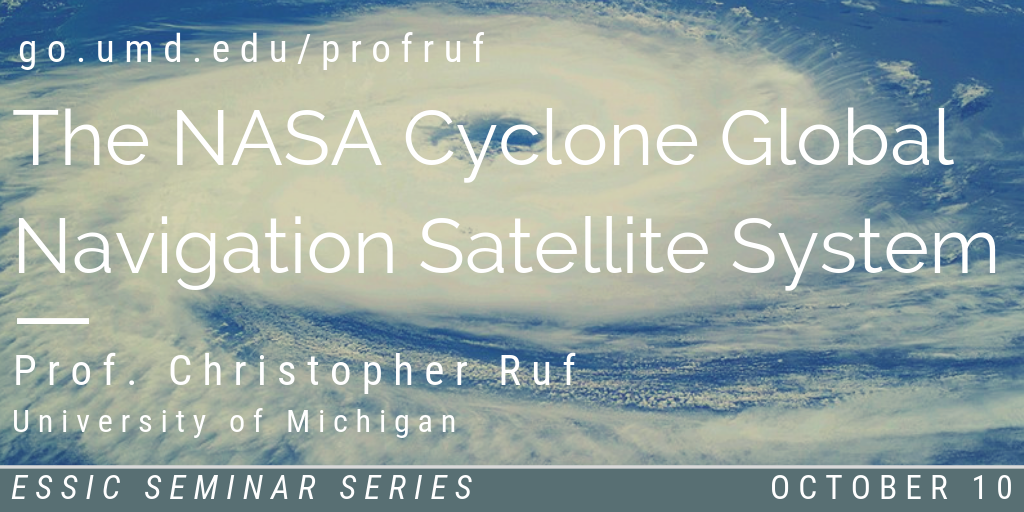
Prof. Christopher Ruf
University of Michigan
Wednesday October 10, 2018, 12:00-1:00 PM
ESSIC Conference Room 4102, 5825 University Research Ct, College Park, MD 20740
Abstract:
The CYGNSS constellation of eight satellites was successfully launched on 15 December 2016 into a low inclination (tropical) Earth orbit. Each satellite carries a four-channel bistatic radar receiver which measures GPS signals scattered by the ocean, from which ocean surface roughness, near surface wind speed and air-sea latent heat flux, and land surface soil moisture and flood inundation are estimated. The measurements are unique in several respects, most notably in their ability to penetrate through all levels of precipitation, made possible by the low frequency at which GPS operates, and in the frequent sampling of extreme weather events and complete sampling of the diurnal cycle, made possible by the large number of satellites. Engineering commissioning of the constellation was successfully completed in March 2017 and the mission is currently in its science operations phase.
Level 2 science data products have been developed for near surface (10 m referenced) ocean wind speed, ocean surface roughness (mean square slope) and latent heat flux. Level 3 gridded versions of the L2 products have also been developed. A set of Level 4 products have also been developed specifically for direct tropical cyclone overpasses. These include the storm intensity (peak sustained winds) and size (radius of maximum winds), its extent (34, 50 and 64 knot wind radii), and its integrated kinetic energy. Assimilation of CYGNSS L2 wind speed data into the HWRF hurricane weather prediction model has also been developed. Measurements over land demonstrate sensitivity to near-surface soil moisture and the ability to image flood inundation.
An overview and the current status of the mission will be presented, together with highlights of on-orbit performance and recent scientific results.
Bio-sketch:
Prof. Chris Ruf is the Frederick Bartman Collegiate Professor of Climate and Space Science, and Professor of Atmospheric Science and Electrical Engineering at the University of Michigan in Ann Arbor. He worked previously at Intel Corporation, Hughes Space and Communication, the NASA Jet Propulsion Laboratory and Penn State University. His research focuses on microwave remote sensing methods and technology for Earth science. Prof. Ruf is former Editor-in-Chief of the IEEE Transactions on Geoscience and Remote Sensing and has been the recipient of numerous NASA and IEEE awards, including IEEE Fellow, and served on the 2005-6 and 2016-7 National Academy of Sciences Earth Science Decadal Survey Panels. He is Principal Investigator of the NASA Cyclone Global Navigation Satellite System (CYGNSS) mission.
Host:
Dr. John Yang, jxyang@umd.edu, ESSIC
(Email John if you would like to meet with Prof. Ruf)
Webex info:
Event number: 733 194 222
Event password: essic
——————————————————-
To join the online event
——————————————————-
1. Click here to join the online event.
Or copy and paste the following link to a browser:
https://umd.webex.com/umd/onstage/g.php?MTID=e3c26266ca3d788a2f5cf6c3ae334ba58
2. Click “Join Now”.
——————————————————-
To join the audio conference only
——————————————————-
US Toll: +1-415-655-0002
Global call-in numbers: https://umd.webex.com/umd/globalcallin.php?serviceType=EC&ED=668515562&tollFree=0
Access code: 733 194 222
——————————————————-
For IT assistance
——————————————————-
Contact Travis Swaim at: tswaim1@umd.edu
Follow ESSIC:
ESSIC homepage: http://essic.umd.edu/
ESSIC seminar calendar: MSQ-4102; http://go.umd.edu/essicseminar
ESSIC twitter: http://twitter.com/ESSICUMD
ESSIC facebook: http://facebook.com/ESSICUMD
ESSIC seminar coordinator: Dr. John Yang, jxyang@umd.edu