
Data for Discovery and Education: Insights From QGreenland’s Integrated GIS Framework
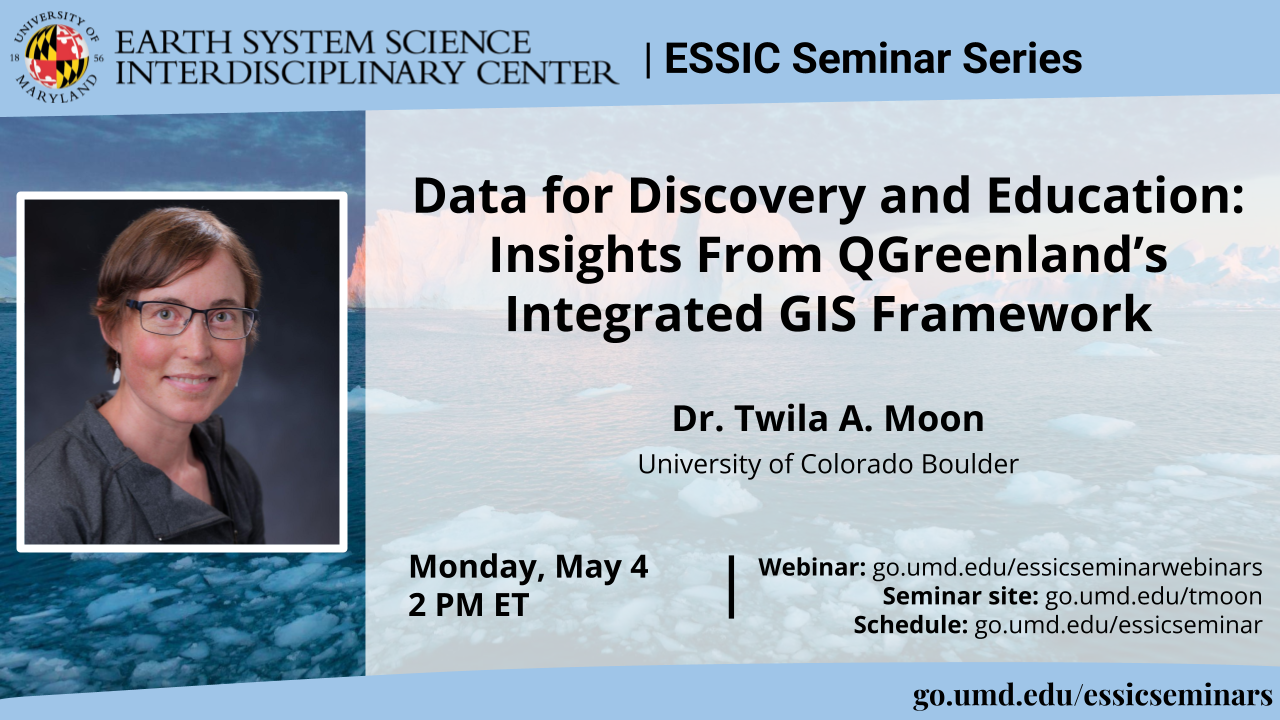
Dr. Twila A. Moon
University of Colorado Boulder
Monday May 4, 2026, 2 PM ET
Abstract:
Synthesizing and effectively using diverse geospatial datasets remains a persistent challenge across Earth system science. QGreenland addresses this challenge for Greenland-focused researchers and educators by providing a free, open-source, and fully integrated GIS data environment, for use with QGIS. By packaging multi-disciplinary datasets—ranging from infrastructure and socio-economic layers to ice dynamics and hydrology—into a unified, analysis-ready framework, QGreenland lowers the barrier to entry for new and experienced GIS users while enabling more efficient scientific workflows.
QGreenland is committed to FAIR (findable, accessible, interoperable, reusable) data principles and making QGreenland use easy. Code development is available via GitHub and data provenance and transformations are tracked and recorded. Through partnerships with the NSF Arctic Data Center and DataONE, a QGreenland Data Portal also supports exploration of >50,000 datasets that include Greenland locations. Extensive tutorials, curriculum materials, and workshops support a wide range of users—from educators introducing GIS concepts to advanced researchers building custom analyses. These resources also serve as a model for developing similar geospatial data environments for other regions or domains. Here, we will share insights from the QGreenland project, currently in its 7th year, to apply in your work. By combining accessible tooling, FAIR data infrastructure, and robust educational support, QGreenland demonstrates how thoughtfully designed GIS ecosystems can accelerate research, enhance teaching, and foster broader participation in geospatial science.
Biosketch:
Dr. Twila A. Moon is Deputy Lead Scientist at the National Snow and Ice Data Center within the University of Colorado Boulder’s Cooperative Institute for Research in Environmental Sciences (CIRES), a global leader in Earth science. In 2025, Dr. Moon also became the first Climate Science Engagement Lead at the CIRES Center for Education, Engagement and Evaluation and launched Engage Climate Science to ensure insights escape academia. Dr. Moon is a world-renowned glaciologist specializing in the connections across ice, climate, ocean, ecosystem, and society – and bringing climate science knowledge to decision makers and business leaders. Her pioneering research focuses on Greenland and the Arctic and has been published in high-impact journals and received global media coverage. Dr. Moon has testified for the U.S. Congress, serves on the U.S. Polar Research Board, is a lead editor for the Arctic Report Card, NOAA’s highest impact annual report, and a Fellow of The Explorers Club. In 2025, she was awarded the American Geophysical Union Pavel S. Molchanov Climate Communications Prize. After completing degrees at Stanford (BS) and University of Washington (MS, PhD), she received Postdoctoral Fellowships for work at the University of Colorado and University of Oregon and held a Lectureship at the University of Bristol (UK) before returning to CIRES in 2017. Additional information is available at www.changingice.com and www.engageclimatescience.org.
Zoom Info:
Event site: https://go.umd.edu/tmoon
Zoom Webinar: https://go.umd.edu/essicseminarwebinars
Zoom Meeting ID: 918 7733 3086
Zoom password: essic
US Toll: +13017158592
Global call-in numbers: https://umd.zoom.us/u/aMElEpvNu
For IT assistance:
Cazzy Medley: cazzy@umd.edu
Resources:
Seminar schedule & archive: https://go.umd.edu/essicseminar
Seminar Google calendar: https://go.umd.edu/essicseminarcalendar
Seminar recordings on Youtube: https://www.youtube.com/user/ESSICUMD