
Welcome to the Fall 2026 ESSIC Seminar Series!
J. Marshall Shepherd, Regents Professor and Associate Dean of Franklin College of Arts and Sciences, University of Georgia Reed Maxwell, William and Edna Macaleer Professor

J. Marshall Shepherd, Regents Professor and Associate Dean of Franklin College of Arts and Sciences, University of Georgia Reed Maxwell, William and Edna Macaleer Professor

By Jason P. Dinh Nigam, a leading scholar in climate dynamics, earned the highest academic honor bestowed by the University of Maryland. University of Maryland Atmospheric

The Brin family’s commitment was matched by a $3.25M award from the state for 2 endowed chairs.

“Hot, sticky, miserable weather” – you might think that description reflects a typical Maryland summer. But actually, those words were written 72 years ago, by glaciologist Carl Benson while working on the Greenland Ice Sheet.

Department of Atmospheric and Oceanic Science (AOSC) Associate Professor Tim Canty has been appointed the Associate Director of Earth System Science Interdisciplinary Center (ESSIC), effective

Despite rising emissions, improved farm management could reduce emissions by about 10% without compromising yields. Rice paddies in Yangshuo, China. The flooded fields traditionally used

In 2023 and 2024, Earth’s average global surface temperature spiked nearly 0.3 degrees Celsius above what was already expected from climate change. Each year was declared the hottest on record and coincided with deadly wildfires, heat waves and historic numbers of climate-related disasters.

On April 25, Earth System Science Interdisciplinary Center (ESSIC) participated in Maryland Day, the University of Maryland’s annual open house event. This marked the 28th

Around the world, rain is falling less often but coming down harder. Plants are responding. For the past several years, ESSIC Scientist Andrew Feldman

ESSIC scientist Liqing Jiang is a co-author of a paper that has received the Frontiers Planet Prize, an international recognition honoring research that advances scientific solutions for planetary health.
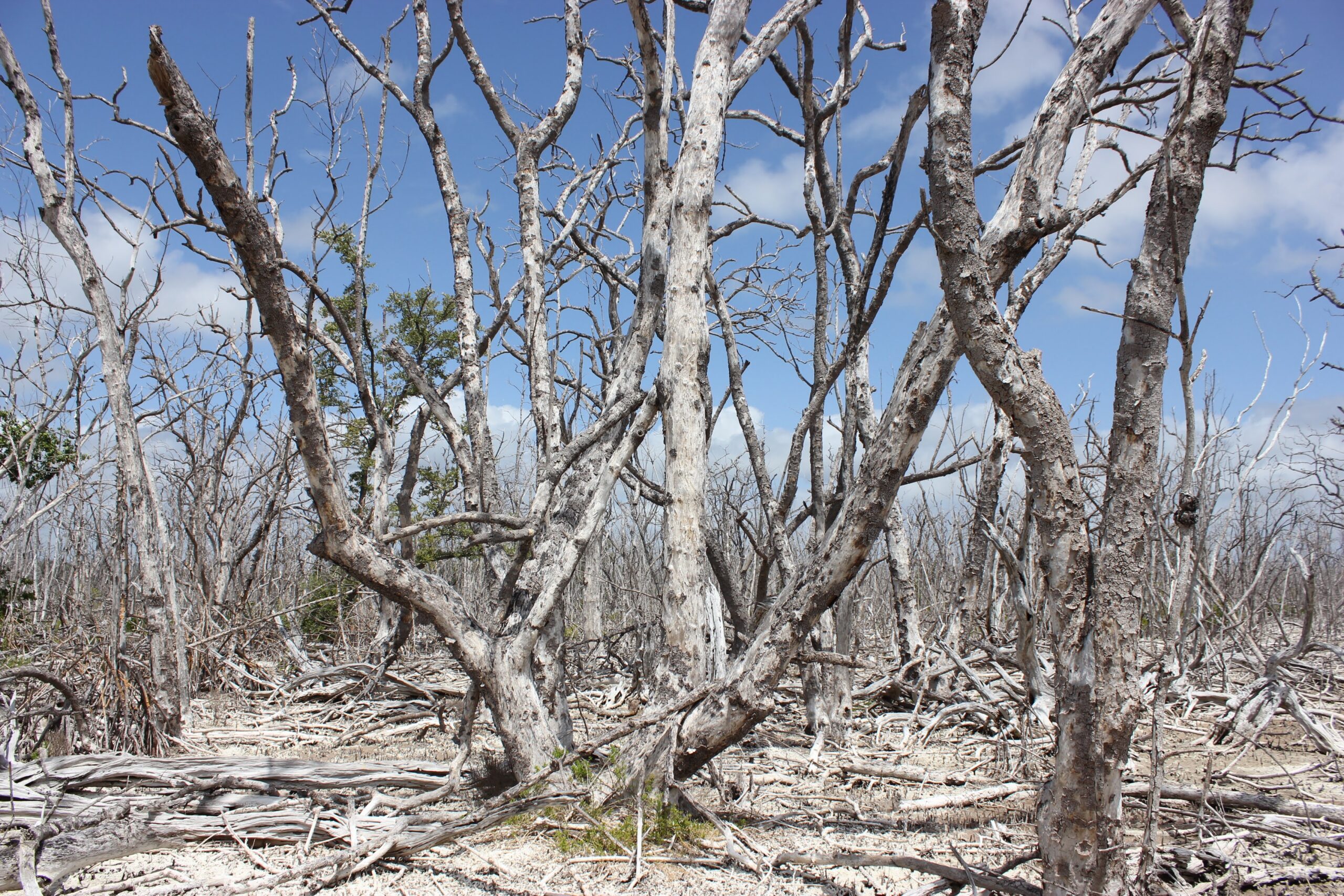
A mangrove “ghost forest” resulting from Hurricane Irma in 2017. Photo by Cheryl Doughty. University of Maryland researchers are uncovering the climate benefits of southern

The ocean plays a critical role in stabilizing Earth’s climate. As the planet’s largest active carbon sink, it absorbs about 25% of global carbon dioxide