ESSIC Celebrates Maryland Day 2022
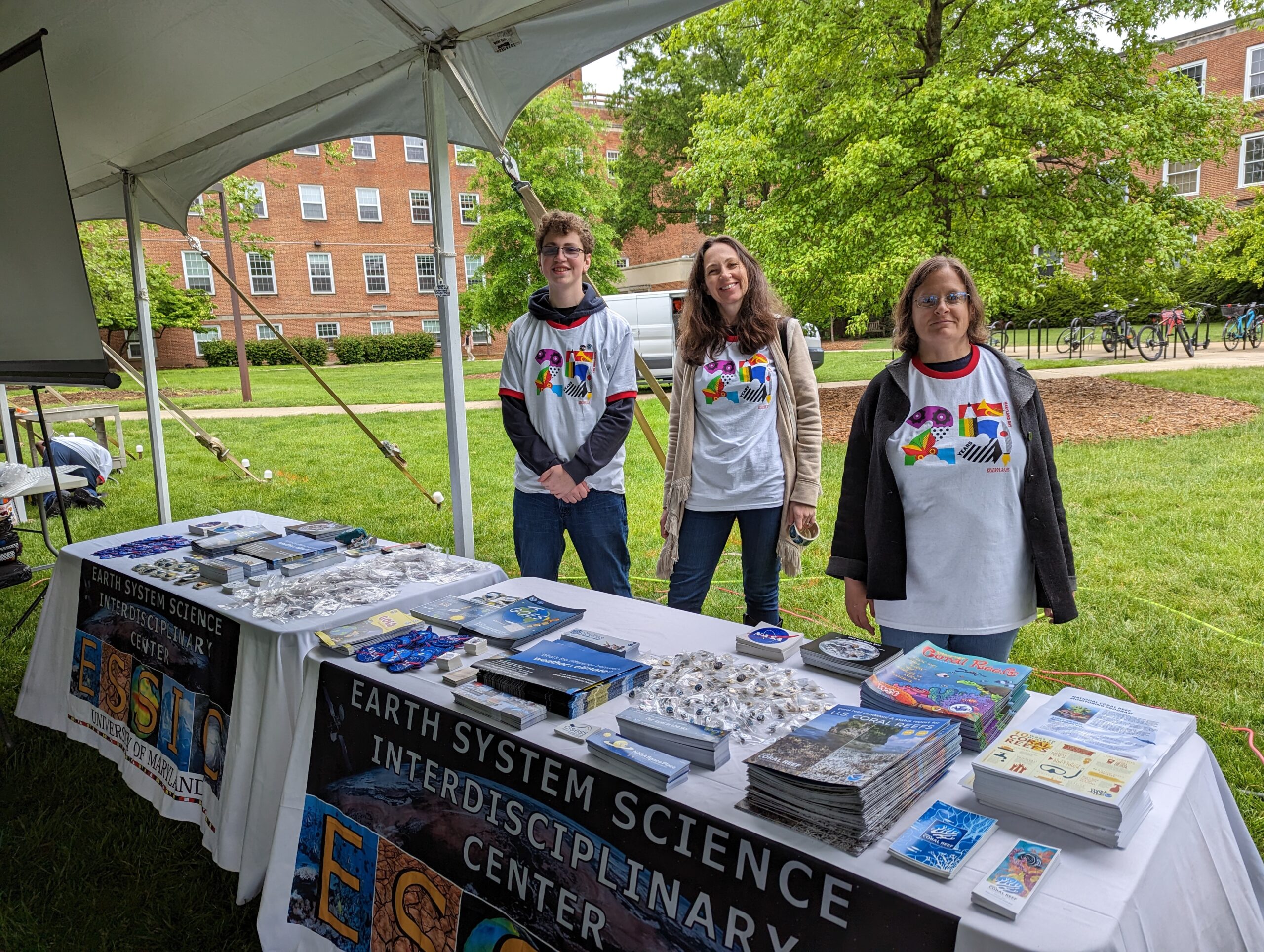
On Saturday, April 30, ESSIC faculty and staff gathered to celebrate Maryland Day, the University of Maryland’s largest community outreach event! This was the first

On Saturday, April 30, ESSIC faculty and staff gathered to celebrate Maryland Day, the University of Maryland’s largest community outreach event! This was the first

For more than 20 years, NOAA Coral Reef Watch (CRW) has been the world’s leader in observing, predicting, and communicating changes in the coral reef environment to a diverse, global user community. In mid-December 2021, CRW’s daily global 5km-resolution satellite coral bleaching heat stress products detected a significant build-up of oceanic heat stress on the Great Barrier Reef (GBR), Australia. This signified the GBR was starting its 2021-2022 summer season with a much earlier onset of accumulated heat stress than ever recorded before. At the same time, CRW’s modeled Four-Month Coral Bleaching Heat Stress Outlook indicated the significant heat stress would continue, leading to a potential mass coral bleaching event on the GBR (following on the heels of confirmed mass bleaching events in 2016, 2017, and 2020).
Two NASA Glaciologists, Kelly Brunt and Alex Gardner, recently sat down to discuss the history, challenges, and evolution of mapping the Antarctic continent and what it means for science and society.

A new paper by the NOAA Coral Reef Watch (CRW) program, an initiative supported by the ESSIC-administered Cooperative Institute for Satellite Earth System Studies (CISESS), shows that Australia’s Great Barrier Reef (GBR) started the 2021-2022 summer season with more accumulated oceanic heat stress than ever before in the satellite record (i.e., 1985 to the present). As of December 14, 2021, NOAA CRW’s daily global 5km satellite coral bleaching heat stress products indicated that instantaneous heat stress and accumulated heat stress over the prior 12 weeks were unprecedented on the GBR.

The American Meteorological Society (AMS) Annual Meeting was held virtually this year from January 23 to 27. Simultaneously, AMS held a number of specialized conferences and symposiums, focusing on topics including hydrology, climate variability and change, and atmospheric chemistry. ESSIC/CISESS scientists contributed a large number of talks and posters at the event. Talks included:

2021’s world ocean was the hottest ever recorded, beating out even last year’s record high temperatures, finds Alexey Mishonov, Jim Reagan, and a team of international scholars.

Xin-Zhong Liang was recently published in Nature’s “News and Views” section giving his insight on new research that reported a comprehensive assessment of changes in gross regional product (GRP) relating to excessive precipitation. The study concluded that increases in the numbers of wet days and in extreme daily rainfall dramatically reduces worldwide macroeconomic growth rates.

ESSIC/CISESS had several talks, e-lightning sessions, posters, virtual town halls, and tutorials at this year’s American Geophysical Union (AGU) Fall Meeting, held in New Orleans and online from December 13 to 17.
CISESS has announced four Seed Grant Program awards to help develop transformative research that requires a proof of concept to assist NOAA in recognizing and supporting new topics that eventually will be carried out in CISESS.

With Halloween behind us, wintery temps are fast approaching College Park! This year, we are resurrecting the historic ESSIC Annual Snow Prediction Pool. This is your opportunity to show off your weather prediction skills to your colleagues and earn bragging rights for the entire 2021-22 snow season.