Headlines:
- La Nina February rainfall pattern still holding on in Pacific
- Dry across southern tier of U.S. with lack of snow in Rockies and wildfires on the Plains
- Conditions slipping toward neutral Pacific conditions with even some forecasts of El Nino later in the year
- Global temperatures high (above global warming trend line) even though global precipitation is below long-term mean (La Nina conditions)
Despite a very warm sub-surface tropical Pacific, the surface temperature (SST) pattern there remains La Nina, i.e., with a negative anomaly (although somewhat weakening, -0.8K). This is linked directly with the relatively weak Pacific ITCZ (see Fig. 1, top panel) and the still strong negative anomaly (see Fig. 1, middle panel) in the central Pacific south of the Equator. The ITCZ in the central Pacific has shifted northward slightly with a very weak ITCZ in the eastern Pacific and a hint of an early Spring double ITCZ in the top panel. The central Pacific negative anomaly field (Fig. 1, middle panel) has matches with the composite La Nina map (Fig. 1, bottom panel). Forecasts are still calling for a return to neutral, or even a coming El Nino, but the La Nina pattern (in surface temperature and rainfall) is still holding for this February.
As befits the La Nina situation the most intense anomaly is still the negative feature centered just south of the Equator at 170°W. From there the negative feature stretches to the east, southeast and west. To its southwest a strong positive anomaly indicates a shift of rainfall in that direction and the Maritime Continent and Philippines are also covered with generally rainy conditions. The Indian Ocean also has the general appearance similar to the La Nina composite with some tropical cyclone activity as expected, but with a dry zone extending east from Madagascar.
Over Africa heavy rains over Mozambique and surroundings produce a positive anomaly not in the La Nina composite, although the rain further south this month does fit the composite. Over South America the mixed anomaly pattern for this month does not fit that expected of La Nina. On the other hand dry conditions dominated over the southern swath of the U.S. These dry conditions with lack of snow out west and even wildfires in Oklahoma, Kansas and eastern Colorado can be linked to the La Nina conditions.
Western Europe had significant precipitation and even floods in France. The positive precipitation anomaly extended to the east and snow was plentiful in the Alps.
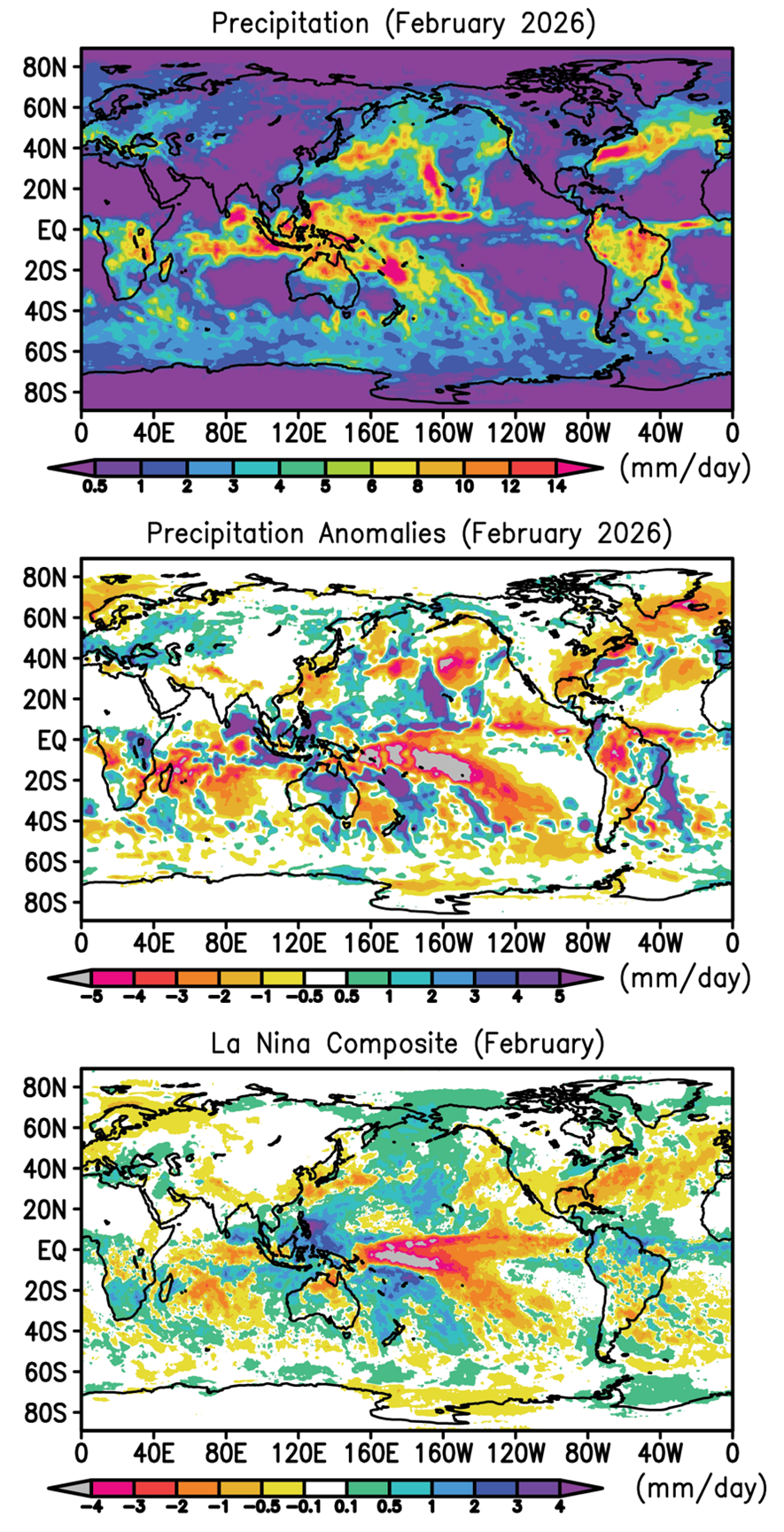
An interesting feature can be seen in all three panels just west of Hawaii with large rainfall values in synch with the La Nina pattern. Associated with “Kona Lows” this feature can be a problem for the islands and that became the case in March with major flooding in Oahu and other islands.
The overall rainfall anomaly pattern in the tropics (see Fig. 2) is still weak La Nina as seen in the spatial correlation history over the last year. However, the La Nina pattern is focused in the Indian Ocean to eastern Pacific with little extension beyond that zone, except over the southern U.S.
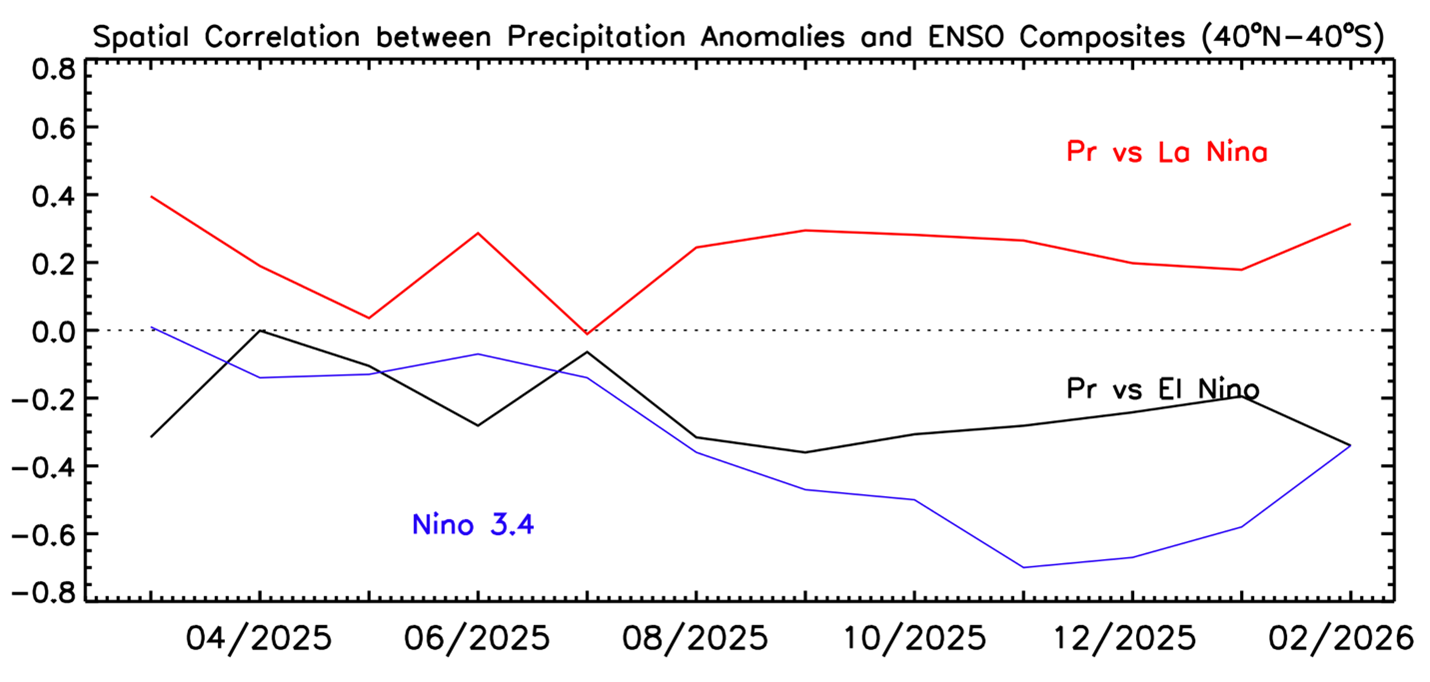
Table 1 gives the global totals for this February and shows the global total below the mean significantly, with the ocean total below and the land value slightly higher than their climatological mean as expected under La Nina conditions.
Table 1. Global precipitation and anomalies in February 2026.
| Mean Precipitation (February 1983-2025) | Precipitation (February 2026) | Precipitation anomaly (February 2026) |
Land+ocean | 2.78 | 2.71 | -0.07 |
Land | 2.12 | 2.24 | +0.12 |
Ocean | 3.06 | 2.90 | -0.15 |
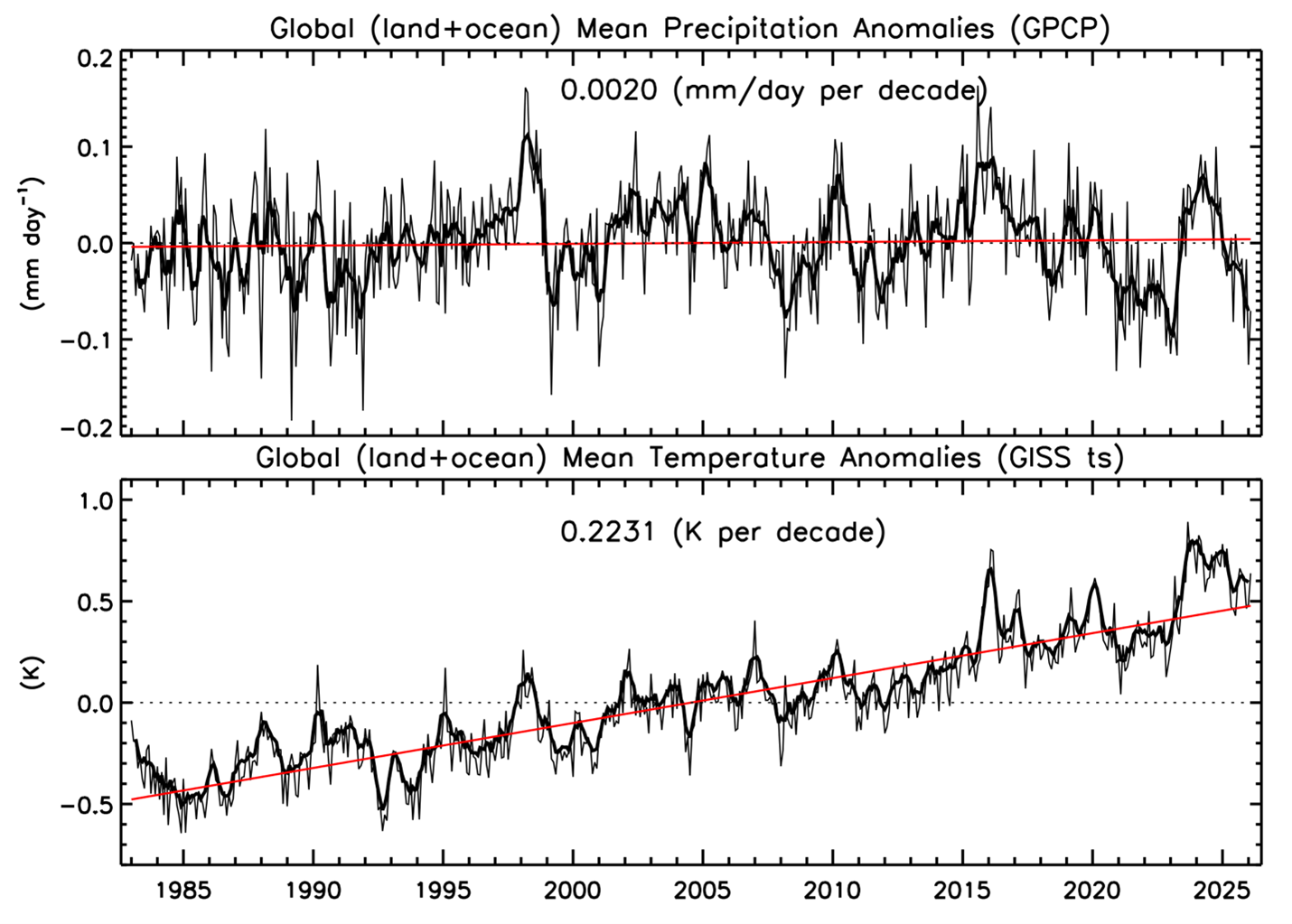
Fig. 3 continues to show an interesting feature of recent months in that while the monthly global precipitation number is well below the mean (La Nina), including this February, the global surface temperature has remained above the fitted trend line that represents the global warming signal. The temperature anomaly from the trend line is usually highly correlated with the straight anomaly of global precipitation—compare the two curves over the last 40 years. However, over the last year or so, while the global precipitation number was below the mean (typical of La Nina), the planet’s surface temperature has remained above the trend curve. Now as we likely move into a retreat from La Nina and move to neutral conditions and even a possible El Nino later in the year, should we expect new record high surface temperatures?
BACKGROUND
The Global Precipitation Climatology Project (GPCP)
This global precipitation summary is based on V3.2 of the Monthly Global Precipitation Climatology Project (GPCP) product, an observation based analysis using satellite observations over oceans and satellite and rain gauge observations over land. The Monthly analysis extends from 1983 to the near present as a Climate Data Record (CDR) with an extension to the previous month (within ~ 12 days of the end of the month) as an Interim CDR, or ICDR.
The development of the GPCP CDR products (Monthly and finer time scales) is supported by NASA’s MEaSUREs program. The GPCP Monthly ICDR was developed and its routine calculation is supported by NOAA’s National Center for Environmental Information (NCEI). GPCP products are available at NASA’s Goddard Earth Sciences Data and Information Services Center (GES DISC) and from NOAA NCEI.
The following references describe GPCP products in detail and provide additional research results using GPCP by the authors of this summary:
GPCP V3.2 paper:
Huffman, G. J. and R. Adler, A. Behrangi, D. Bolvin, E. Nelkin, G.Gu and M. Ehsani, 2023. The New Version 3.2 Global Precipitation Climatology Project (GPCP) Monthly and Daily Precipitation Products. J. Climate, 36, 7635- 7655. DOI: 10.1175/JCLI-D-23-0123.1.
GPCP V2.3 paper:
Adler, R., M. Sapiano, G. Huffman, J. Wang, G. Gu, D. Bolvin, L. Chiu, U. Schneider, A. Becker, E. Nelkin, P. Xie, R. Ferraro, D. Shin, 2018. The Global Precipitation Climatology Project (GPCP) Monthly Analysis (New Version 2.3) and a Review of 2017 Global Precipitation. Atmosphere. 9(4), 138; doi:10.3390/atmos9040138
Other references:
Adler, R., G. Gu, M. Sapiano, J. Wang, G. Huffman 2017. Global Precipitation: Means, Variations and Trends During the Satellite Era (1979-2014). Surveys in Geophysics 38: 679-699, doi:10.1007/s10712-017-9416-4
Adler, R. F., G. Gu, G. J. Huffman, R. P. Sapiano and J. Wang, 2020: GPCP and the Global Characteristics of Precipitation. In Satellite Precipitation Measurement, Vol. 2, Chapter 35, 677-697. Advances in Global Change Research, 69, Springer Nature, doi:10.1007/978-3-030-35798-6_11.
Gu, G., and R. Adler, 2023. Observed Variability and Trends in Global Precipitation During 1979-2020. Climate Dynamics, 61, 131-150.
Adler, R. and G. Gu, 2024. Global Precipitation for the Year 2023 and How It Relates to Longer Term Variations and Trends. Atmosphere, 15(5). 10.3390/atmos15050535.
Gu, G. and R. Adler, 2024. Variability and Trends in Tropical Precipitation Intensity in Observations and Climate Models. Climate Dynamics, https://doi.org/10.1007/s00382-024-07287-y.