Machine Learning for More Accurate Global Sea Surface Temperature Records

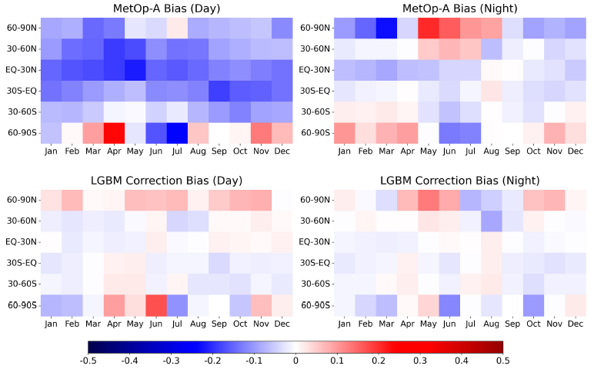
Monthly heat map of SST bias
Figure: Monthly heat map of SST bias: original Metop-A (top panels) and corrected by the LGBM method (bottom panels) during daytime and nighttime. Biases after LGBM correction are lower, especially in the tropics and midlatitudes.

Accurate long-term sea surface temperature (SST) data, important for weather prediction and climate system monitoring, are essential for near-real-time anomaly determination and global trend prediction. Ships and buoys provide in-situ information but are limited in terms of spatiotemporal coverage. Satellite-based SST retrievals from the Advanced Very High-Resolution Radiometer (AVHRR) instrument offer global coverage over the oceans, covering the entire satellite era. However, they are prone to biases from various sources, such as cloud contamination and inaccuracies of sensor calibration, among others.


Mitigating these biases is the subject of a paper by CISESS Scientist Andrew Harris and colleagues who explore the use of machine-learning (ML) methods to do this, comparing their performance against traditional linear regression-based SST algorithms (multiple linear regression, sensor-specific error statistics, and empirical orthogonal teleconnections). They use the Level-2 product produced by NOAA’s Advanced Clear-Sky Processor for Ocean enterprise system and based on SST data (2007–2018) from the European Space Agency’s Meteorological Operational Satellite-A (Metop-A) satellite. The fifth generation European Centre for Medium-Range Weather Forecasts atmospheric reanalysis and Modern-Era Retrospective Analysis for Research and Applications version 2 data are used to estimate atmospheric properties affecting bias, identifying the most important variables for model training purposes. The four non-linear ML methods considered are the random forest, the light gradient boosting machine (LGBM), the deep neural network, and the tabular network. Overall, the authors find that LGBM does the best job of correcting Metop-A SST biases globally during daytime and nighttime, with cost-effective computing time.

Citation: Lee, Seonju, Andrew Harris, and Thomas M. Smith, 2026: SST bias correction using machine-learning methods. J. Atmos. Ocean. Tech., 43, 1141–1157, https://doi.org/10.1175/JTECHD-25-0056.1.

This article was put together based on scientist input.