Assessing Passive Microwave-Detected Convective Rainfall

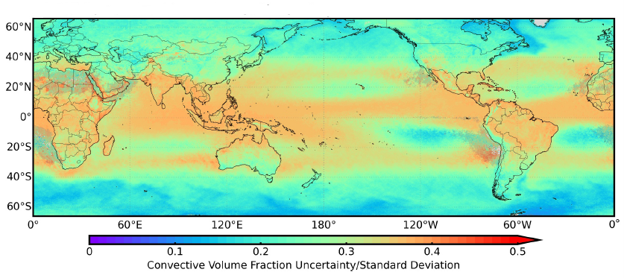
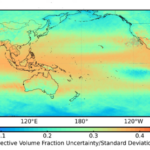
Global distribution of the uncertainty of GMI convective volume fraction
Figure: Global distribution of the uncertainty of GMI convective volume fraction (CVF; resolution: 0.25°). CVF uncertainty is highest in areas dominated by non‐shallow convective precipitation, mainly between 40°S and 40°N.

How accurately can passive microwave (PMW) sensors detect convective precipitation? That is the question posed in a paper by ESSIC/CISESS Scientists Lei Ji and Veljko Petković and Naval Postgraduate School’s Marko Orescanin published in the Journal of Geophysical Research: Atmospheres.


They use eight years (2015–2023) of collocated observations from the Global Precipitation Measurement mission Core Observatory Microwave Imager (GMI) and Ku‐band Precipitation Radar (KuPR) in their analysis, with the latter serving as the reference dataset. Two‐meter temperature (T2m) and total column water vapor (TCWV) from the ERA5 reanalysis are used to describe environmental conditions. The standard deviation of the difference between KuPR and GMI convective volume fractions (CVFs) quantifies the PMW CVF uncertainty.


They report that over the ocean, convective precipitation is generally underestimated by the PMW product except when there is plentiful water vapor (TCWV > 60 mm) or high surface temperatures (T2m > 304 K). Over land, the PMW product is generally overestimated but tends to be underestimated under relatively low water vapor and surface temperature conditions (TCWV < 45 mm and T2m < 285 K). These new insights, among others, into regional precipitation characteristics will be instrumental in improving the operational PMW algorithm.

Author

Picture of Maureen Cribb

Maureen Cribb

Maureen Cribb has been with ESSIC since 2001, first as a faculty specialist then as a senior faculty specialist, working in Prof. Zhanqing Li’s group. She is also a member of the CISESS Coordinator team. Maureen received a B.Sc. in Applied Mathematics from Concordia University (Montréal, Canada) and a Diploma in Meteorology from Dalhousie University (Halifax, Canada). After a stint as a data analyst at the Bedford Institute of Oceanography near Halifax, she earned an M.Sc. in Atmospheric Science from Dalhousie, investigating the influence of the three-dimensional structure of clouds on the atmospheric absorption of solar radiation under the supervision of Prof. Qiang Fu. She lives, works, and plays in College Park, i.e., biking around on the hiker/biker trails, exploring the local food scene, and watching footie at sports restaurants in the area.