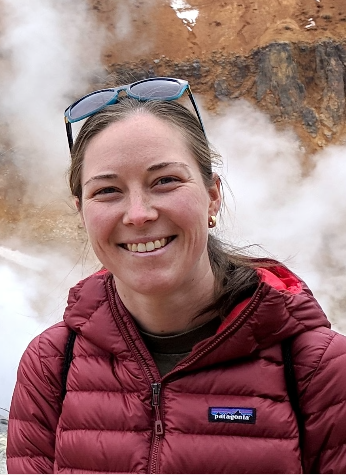
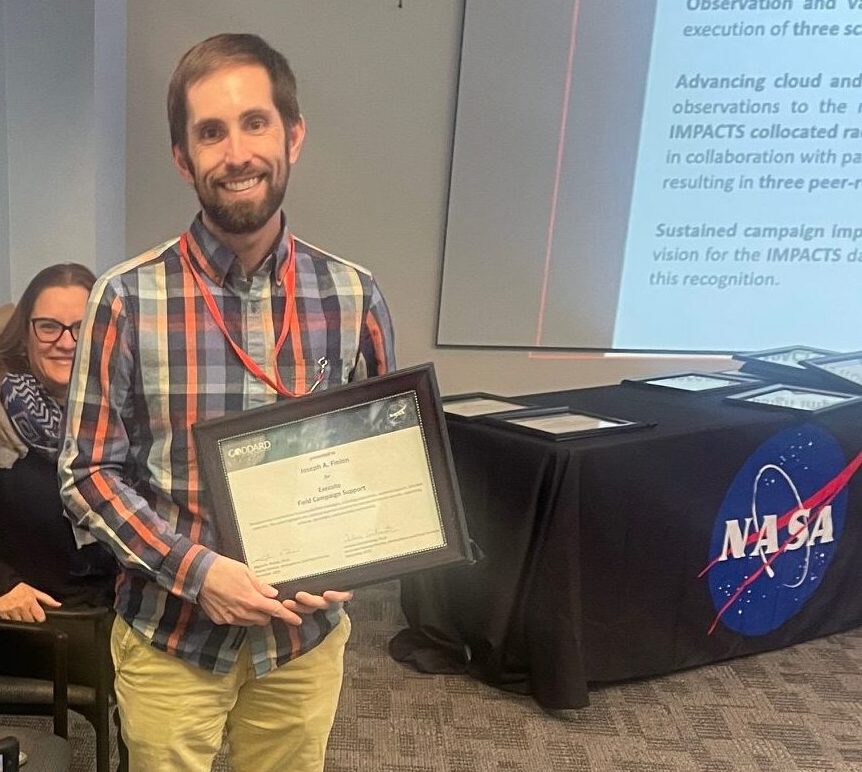
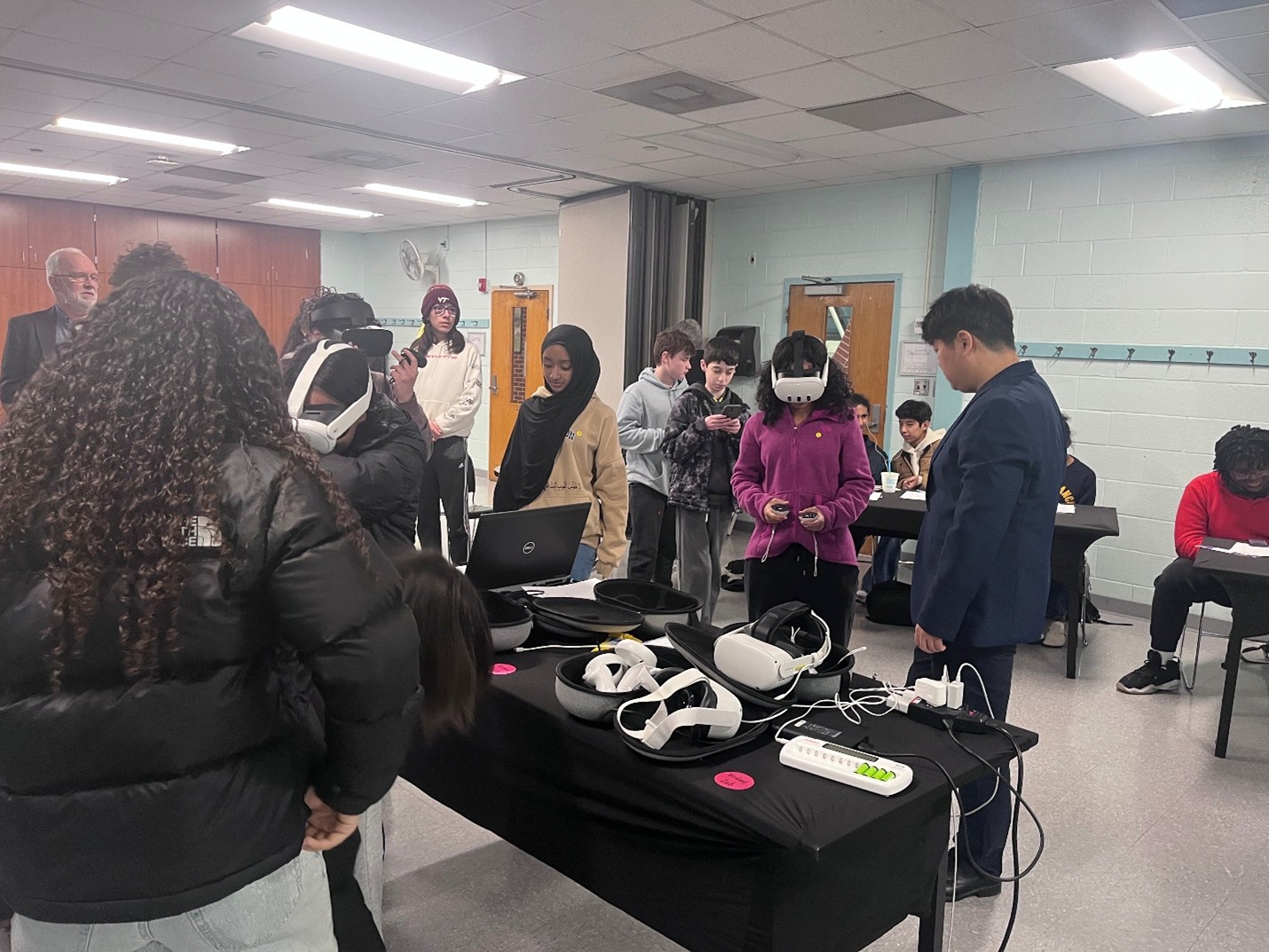
Last week, the Earth System Science Interdisciplinary Center held their annual Collaborative Partner Reception and Awards Ceremony. During the event, ESSIC Director Lars Peter Riishojgaard presented the end-of-year awards, Employee of the Year, Best First Author Paper, and Best Technical Achievement.
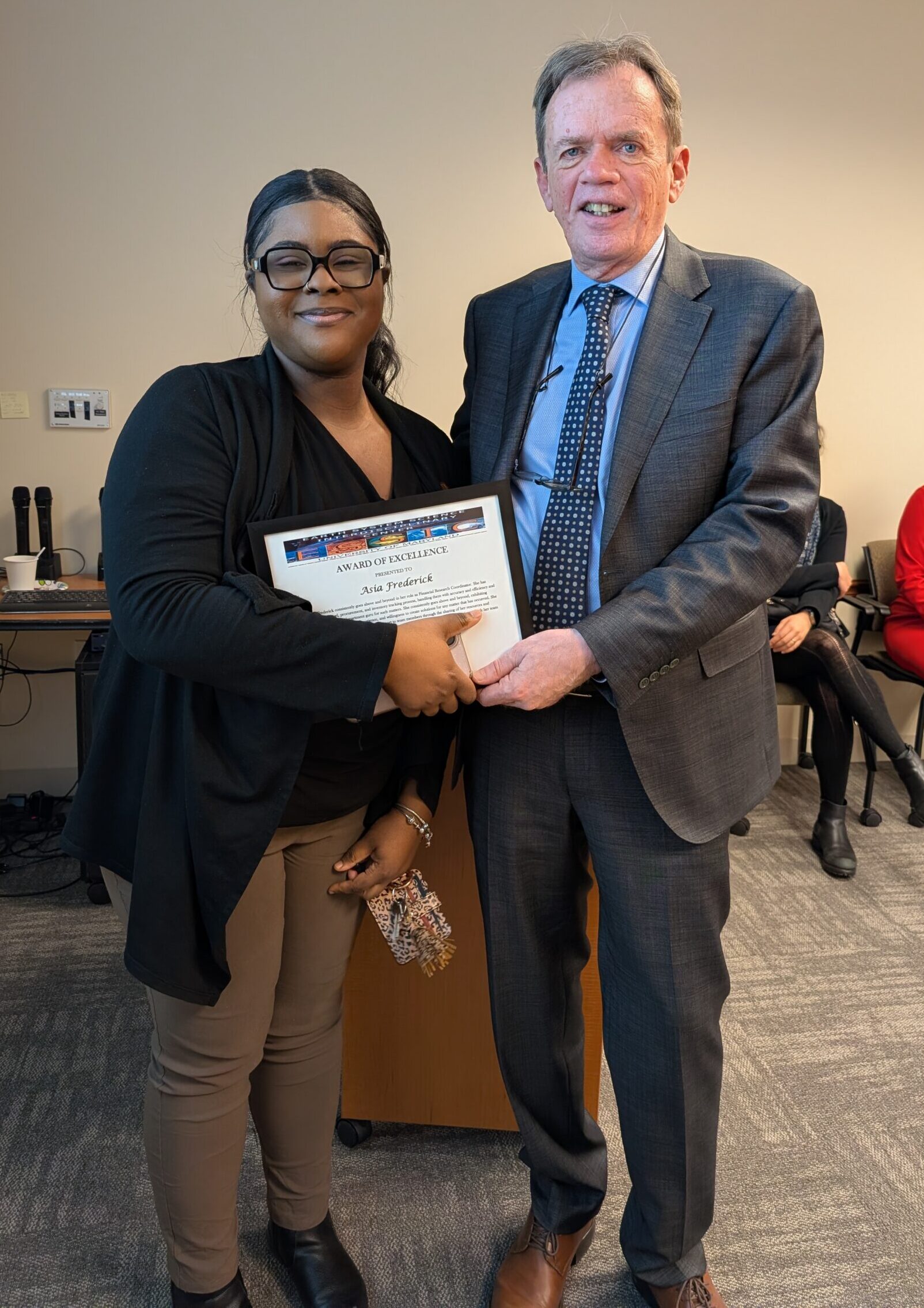
Employee of the Year: Asia Frederick
Asia Frederick consistently goes above and beyond in her role as Financial Research Coordinator. She has streamlined the travel, procurement, and inventory tracking process, handling them with accuracy and efficiency and even becoming the department guru for such matters. She consistently goes above and beyond, exhibiting tremendous problem solving, skill, patience, and willingness to create solutions for any matter that has occurred. She is also eager to offer her expertise and support to team members through the sharing of her resources and knowledge. Frederick has consistently exemplified outstanding performance and unwavering dedication to both her team and to ESSIC.
The Employee of the Year committee was chaired by Ann Legall and also consisted of Maureen Cribb and Cazzy Medley.

Best Paper: Allison Chartrand, “Thwaites Glacier thins and retreats fastest where ice-shelf channels intersect its grounding zone”
Chartrand et al. (2025) use 12 years of 10-m REMA digital surface models, altimetry, and a novel hydrostatic boundary mapping technique to track grounding-zone retreat, thinning, and melt across Thwaites Glacier with unprecedented spatial detail. They show that ice-shelf channels aligned with subglacial drainage pathways correspond to the fastest and most extreme retreat (up to ~0.7 km/yr) and basal melt rates (~250 m/yr), providing clear observational evidence of ongoing unstable retreat consistent with marine ice-sheet instability.
This study addresses an important scientific question of Thwaites Glacier stability by linking grounding-zone instability directly to the geometry and evolution of ice-shelf channels. This is an emerging mechanism that has not been quantified at this spatial or temporal scale. The authors use novel and rigorous methods, by combining multiple observations, strict quality filtering, transparent error analysis, and a sophisticated hydrostatic- boundary framework. The writing, figures, and interpretation are outstanding, and the results are profoundly important. The authors identify clear vulnerability factors, provide a predictive retreat classification framework that can be used for other glaciers, and demonstrate the active, ongoing marine ice-sheet instability at Thwaites which has significant implications for global sea level rise.
Chartrand, A. M., Howat, I. M., Joughin, I. R., & Smith, B. E. (2024). Thwaites Glacier thins and retreats
fastest where ice-shelf channels intersect its grounding zone. The Cryosphere, 18(11), 4971-4992. https://tc.copernicus.org/articles/18/4971/2024/
Best Technical Achievement: Jifu Yin, “Reprocessed NOAA SMOPS Blended Soil Moisture Product as a Climate Data Record”
The study presents the first NOAA long-term SMOPS Climate Data Record (SMOPScdr), a globally consistent, 20+-year blended soil-moisture product integrating six active and passive microwave sensors using advanced methods—machine-learning AMSR retrievals, radiance intercalibration, CDF-matching bias correction to SMAP, and observation-driven quality control. The resulting dataset provides daily global coverage (~95%), high accuracy (correlation with SMAP r = 0.96), and validated long-term consistency against both SMAP and international in situ networks.
The SMOPScdr dataset is fully operational and public, with clear and complete documentation, stable versioning, and strong transparency of the novel methodology, giving users explicit insight into data lineage, assumptions, uncertainties, and validation approaches. The product has daily, long-term, and global coverage that is updated operationally. The dataset can robustly be used across scales and applications from local planning (e.g. agricultural drought early warning); monitoring (e.g. flood monitoring); data assimilation for weather and climate models; to climate analyses (e.g. global drying). There are tangible implications for public resilience, hazard preparedness, and climate-change assessment.
Yin, J., Zhan, X., Liu, J., Barlage, M., Meng, H., Kalluri, S., … & Ferraro, R. R. (2025). Reprocessed NOAA
SMOPS Blended Soil Moisture Product as a Climate Data Record. Bulletin of the American Meteorological Society, BAMS-D. https://journals.ametsoc.org/view/journals/bams/106/8/BAMS-D-23-0248.1.xml
The Best Paper and Best Technical Achievement committee was chaired by Chelsea Parker and also consisted of Abheera Hazra, Paige Lavin, Veljko Petkovic, and Heshun Wang.