Prize-winning research co-authored by ESSIC scientist identifies a major shift in ocean chemistry
ESSIC scientist Liqing Jiang is a co-author of a paper that has received the Frontiers Planet Prize, an international recognition honoring research that advances scientific solutions for planetary health.
The paper, titled “Ocean Acidification: Another Planetary Boundary Crossed” builds on a 2009 assessment that defined nine environmental thresholds that, if crossed, could lead to irreversible environmental change that could endanger human life. One of those thresholds involves ocean acidification, or the reduction in pH of the ocean over time caused by increased carbon dioxide in the atmosphere. In the 2025 paper, Jiang and his co-authors found that the global ocean had already crossed this ocean acidification boundary – in 2020.
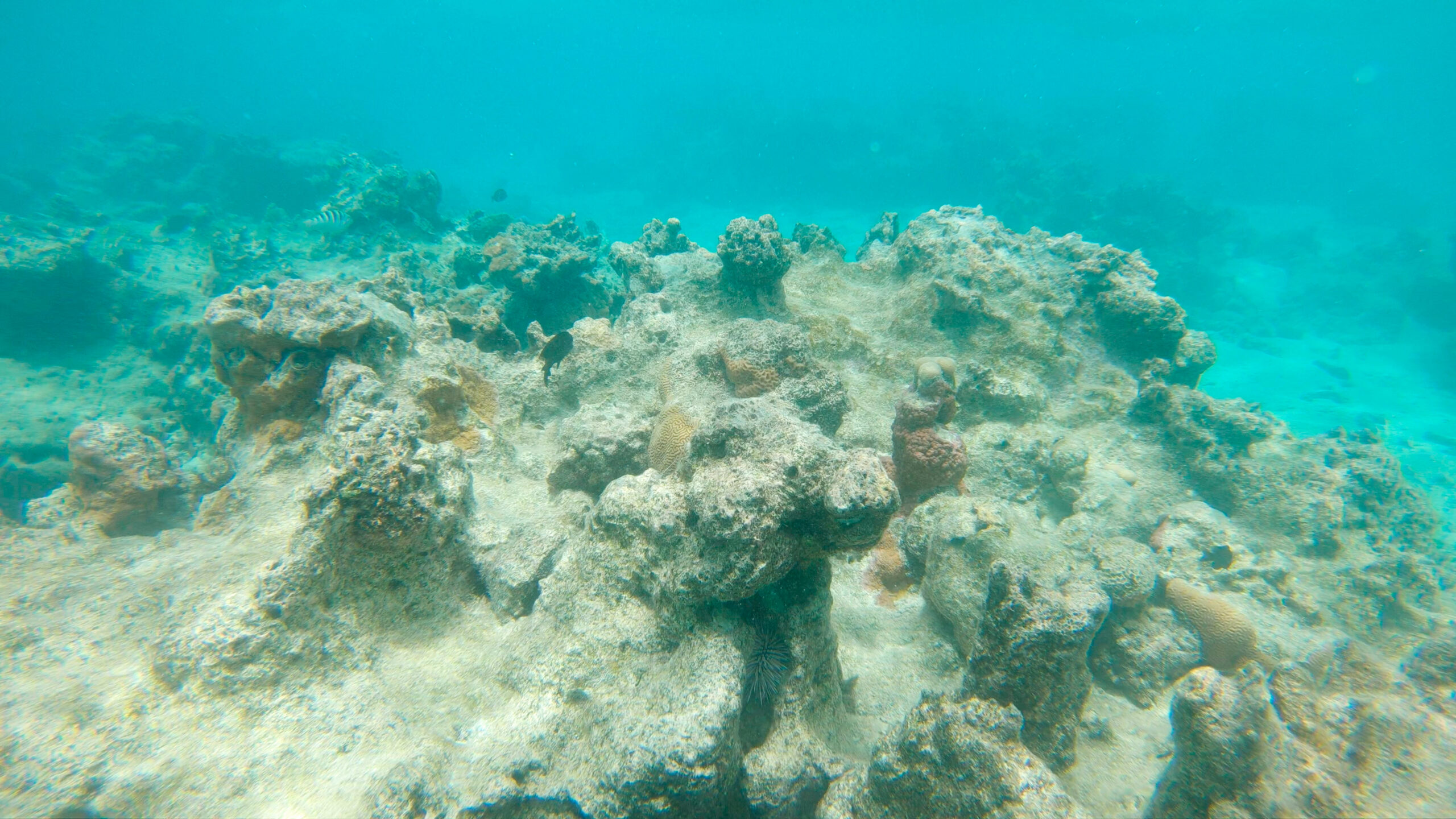
“Crossing a planetary boundary means we are moving out of the Earth system’s ‘safe operating space’ and into conditions where the risk of widespread, potentially unacceptable environmental change rises sharply,” said Jiang, “In practice, this means ocean acidification is shrinking suitable habitat for organisms that build shells and skeletons, including coral reefs, pteropods, and coastal bivalves.”
The ocean absorbs about 25% of the carbon dioxide released into the atmosphere annually. As levels of carbon dioxide increase due to human activities, the ocean becomes more acidic. Increased acidity leads to a decrease in calcium carbonate, the primary building block of shell builders like oysters and corals. Jiang and his co-authors found that by 2020, the changing ocean chemistry has resulted in 43% fewer tropical and subtropical coral reefs and significant habitat loss for polar pteropods (also called sea butterflies) and coastal bivalves (mollusks including oysters and scallops).
However, the most significant changes in ocean chemistry occur out of sight. 200 meters below the surface is the subsurface ocean, home to sensitive organisms such as corals, pteropods, shellfish, and deep reef ecosystems. At this depth, higher carbon dioxide levels and a lack of chemicals that buffer against acidity cause pH to decline and carbonate ions to reduce faster. The researchers found that up to 60% of the global subsurface ocean had already crossed the benchmark defining dangerous levels of ocean acidification. Major shifts occurring in the subsurface ocean could severely impact deep-sea marine ecosystems and disrupt critical services the ocean offers, such as carbon dioxide sequestration, and fisheries and the aquaculture industry.
Considering these compounding factors of a more acidic ocean, Jiang and his co-authors suggest a new planetary boundary: a 10% reduction from pre-industrial conditions, a benchmark which was surpassed by year 2000 across the entire surface ocean.
“The revised 10% threshold reflects a shift from a purely chemical definition of the ocean acidification boundary to one grounded in ecological risk,” said Jiang, “We show that significant habitat loss and biological impacts occur well before the previously proposed ~20% reduction, meaning the earlier boundary was not sufficiently protective.”
Jiang and his colleagues believe that this new threshold more adequately prevents risk to marine ecosystems and their services.
“Although this threshold was exceeded globally by around 2000, this is intentional: planetary boundaries are designed to diagnose whether Earth systems are already operating outside a safe space, not to predict distant tipping points,” said Jiang, “The result reframes ocean acidification as a present-day, system-wide risk rather than a future concern.”
How can we turn back the clock on the ocean to the year 2000? By reducing our reliance on fossil fuels, Jiang says. Globally, per capita carbon dioxide emissions are about 5 tons per year. Transitioning to alternative energy sources is the primary way to slow the decline of ocean pH.
For now, Jiang will continue his work on the subsurface ocean.
“This study emphasizes that the subsurface ocean impacts require more focus, especially to protect mesopelagic and deep-sea habitats. Additionally, we need to consider compound stressors such as warming, low oxygen, and acidity together rather than in isolation,” said Jiang.