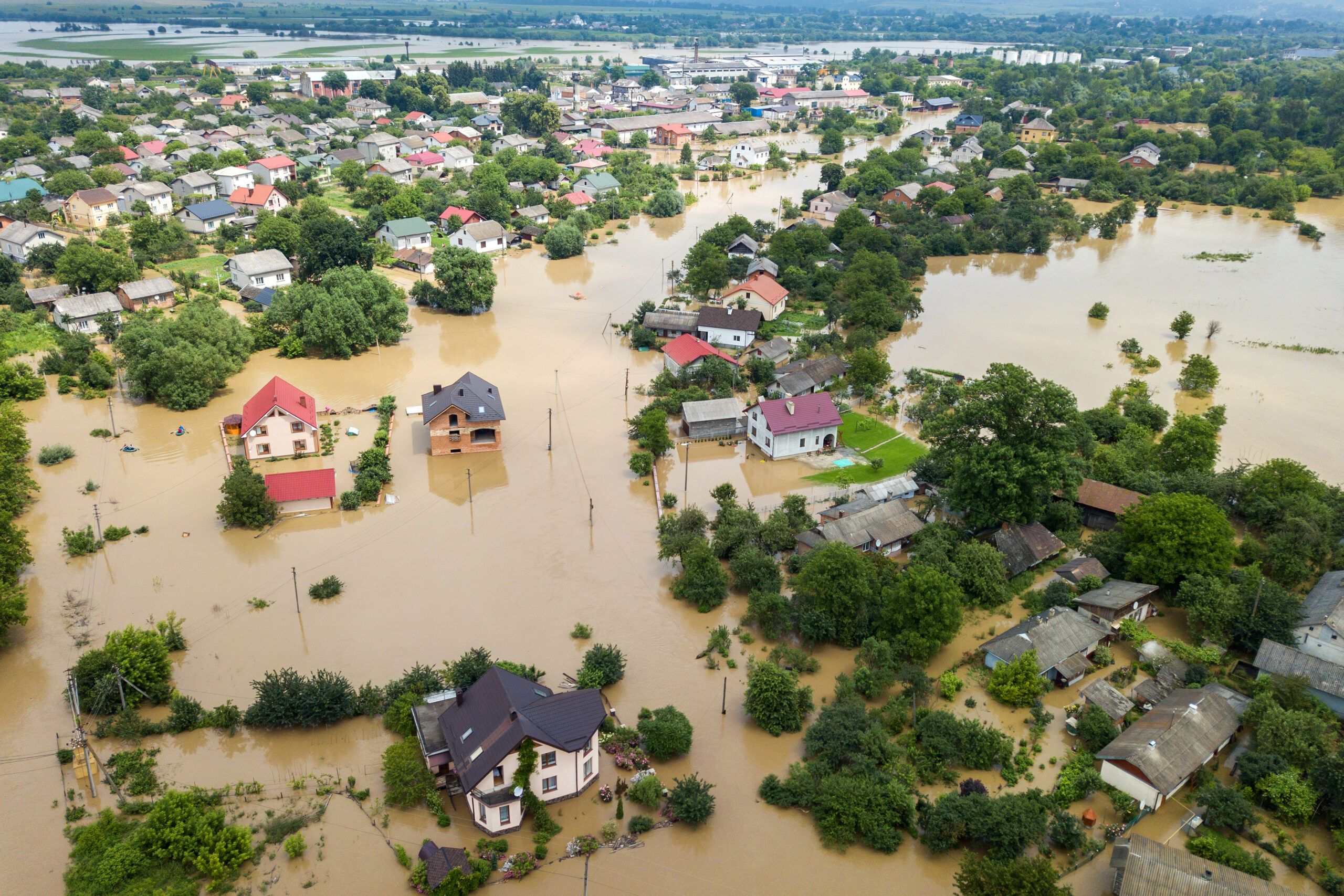
Around the world, rain is falling less often but coming down harder. Plants are responding.
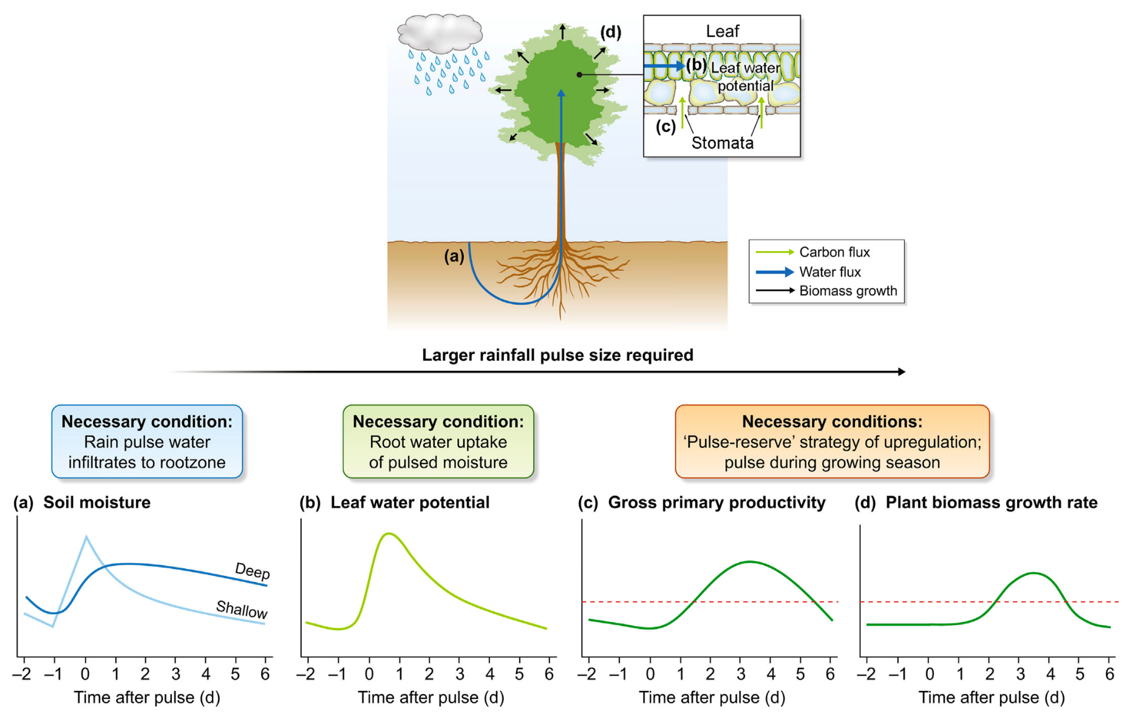
For the past several years, ESSIC Scientist Andrew Feldman has dedicated his research to discovering how this new rainfall pattern affects plant growth around the world using satellites. In a 2025 paper published in New Phytologist, Feldman argues that short rainfall events, known as “rainfall pulses”, likely play a much bigger role in controlling plant photosynthesis and carbon uptake than is currently recognized.
The pulse of plants
Throughout his research, Feldman found that these pulses can directly stimulate photosynthesis and growth across many global ecosystems, and that these effects can continue for several days afterwards as plants slowly take up water. This could influence how plants store carbon dioxide and release water to the atmosphere over time.
“We tend to think that plants are slowly responding to week-to-week variations in light, temperature, and moisture. However, if a brief addition of water to the soil causes plant photosynthetic processes to have a prolonged response, then plants don’t always quickly forget that a rain event occurred,” said Feldman, “This means that if plants are substantially responding to each pulse, then rainfall pulses are collectively having a surprising amount of influence on plant behavior over a season or year.
“You can think of it this way: if you have a house plant and only a jug of water for the week, should you drench your plant with the full jug on Sunday? Or should you space it out in smaller additions on Monday, Wednesday, and Friday? One could argue that since it is the same amount of water, there isn’t much of a difference.”
However, Feldman’s research shows that plants can have very different responses to the large all-at-once rain events versus smaller events.
“How you pour this jug of water on the plant over a week is likely to have different consequences for photosynthesis, growth, and overall health of the plant, despite it being the same amount of water.”
Because they occur over such short periods, rainfall pulses aren’t fully represented in current ecosystem and climate models. Most modeling focuses on monthly, seasonal, and annual timescales, with the prevailing thought being that daily-scale variations average out over the month. But Feldman’s paper argues for far more consideration of daily-scale pulse dynamics.
Satellites as a way forward
After an initial competition amongst early career plant scientists for their contributions to the field, Feldman was selected as a finalist for the 2025 New Phytologist Tansley Medal for excellence in plant science. Part of this accolade was being invited to write this New Phytologist paper . He sees this work even being considered as ‘plant science’ as clearing a big hurdle.
“Use of satellite remote sensing to study plants isn’t new,” said Feldman, “However, historically, plant scientists have infrequently interacted with satellite data because of the deeper, up-close level of detail plant physiologists need for in their mechanistic studies. I think the wider breadth of tools and higher spatial and temporal resolutions of the satellite measurements now allow more insights into the same mechanisms that plant scientists study in the field. For example, satellite measurements are increasingly available at several-meter scales, which allows investigations of small plots of vegetation that ecologists focus on in the field, and at sometimes hourly to daily timescales, to meaningfully evaluate rapid changes in leaf-level functioning. While we can’t replace detailed plant physiological lab and field-based studies, advances in satellite technology are allowing deeper and more meaningful evaluations of plant mechanisms than ever before.”
Branching off of this work, Feldman is now investigating how much detail about daily rain-plant responses is necessary to accurately forecast plant behavior on a NASA-funded grant. Through better understanding plant responses to rainfall pulses, Feldman hopes we can better predict how much vegetation grows and yields in agricultural crop and rangeland systems over a year. This can inform how we might irrigate crops and informs which species will thrive under different rainfall conditions.
Feldman is one of only a few finalists for the Tansley Medal over its history that conducts plant science research mainly using satellite remote sensing. He sees this as a breakthrough for remote sensing sciences into this field and hopes his work encourages others to pursue plant science unknowns from space.
“I think this [work] signals that some components of plant sciences can, with proper understanding and carefully linking to processes, be meaningfully researched from space,” said Feldman. “And they have the potential to go where no one has gone before with the power of repeated and vast spatial coverage.”