UMD Scientist Helps Certify Two New Megaflash Lightning Records
Daile Zhang serves on the World Meteorological Organization’s Committee on Weather and Climate Extremes.

Daile Zhang serves on the World Meteorological Organization’s Committee on Weather and Climate Extremes.

Scott Rudlosky and Joseph Patton led an AMS short course titled “Accessing and Applying Geostationary Lightning Mapper Observations” on January 5 and 6. This two-part course introduced the GLM observations and imagery using GLM flash skeletons and gridded products used by the National Weather Service. Participants were shown how to access archived and real-time imagery before conducting a hands-on exercise illustrating their new-found skills. Additional information can be found at this link: Accessing and Applying Geostationary Lightning Mapper Observations.

ESSIC/CISESS Scientist Fangfang Yu (STAR/SMCD/SCDAB) has a new article in the Journal of Applied Remote Sensing, co-written with Hyelim Yoo, Haifeng Qian, and Xi Shao. The paper describes the radiometric calibration of the Advanced Baseline Imager (ABI) Infrared (IR) channels on GOES-16.

ESSIC/CISESS scientists Soni Yatheendradas and Sujay Kumar are co-authors on a paper in Journal of Hydrometeorology titled, “A novel Machine Learning-based gap-filling of fine-resolution remotely sensed snow cover fraction data by combining downscaling and regression”.

2021’s world ocean was the hottest ever recorded, beating out even last year’s record high temperatures, finds Alexey Mishonov, Jim Reagan, and a team of international scholars.

Xin-Zhong Liang was recently published in Nature’s “News and Views” section giving his insight on new research that reported a comprehensive assessment of changes in gross regional product (GRP) relating to excessive precipitation. The study concluded that increases in the numbers of wet days and in extreme daily rainfall dramatically reduces worldwide macroeconomic growth rates.

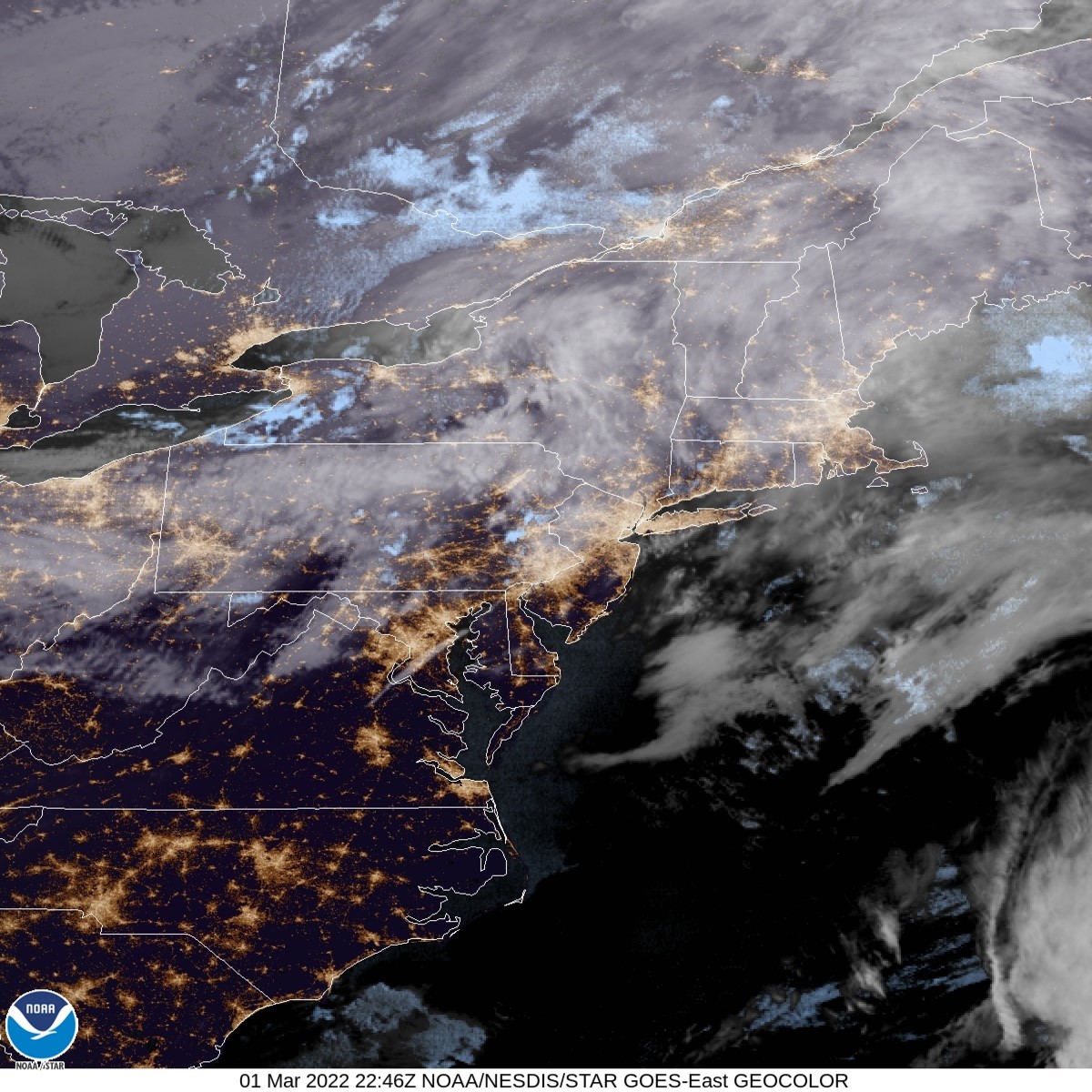
The first nor’easter of 2022 swept through the Mid-Atlantic and the Northeast on January 2-4, 2022, resulting in a heavy snow accumulation of up to 14 inches in Virginia and southern Maryland and stranding hundreds of drivers on Interstate 95 in Virginia. The NOAA NESDIS Snowfall Rate (SFR) product captured the evolution of the snowstorm with retrievals from the Advanced Technology Microwave Sounder (ATMS) sensor aboard the S-NPP and NOAA-20 satellite missions, and the AMSU-A/MHS sensors aboard NOAA-19, Metop-B, and Metop-C.

ESSIC/CISESS had several talks, e-lightning sessions, posters, virtual town halls, and tutorials at this year’s American Geophysical Union (AGU) Fall Meeting, held in New Orleans and online from December 13 to 17.
CISESS has announced four Seed Grant Program awards to help develop transformative research that requires a proof of concept to assist NOAA in recognizing and supporting new topics that eventually will be carried out in CISESS.

As part of the NASA grant, UMD, NASA Jet Propulsion Laboratory, NOAA, United States Coast Guard, Watermapping Ltd., Maryland Department of Agriculture, Environment Canada, and Marine Spill Response Corporation participated in an experiment to compare oil thickness measurements (both in situ and remotely) in the hopes of validating an oil thickness product. By finding the thickest oil layers, researchers can identify key zones to bring in remediation equipment and clean up the most harmful oil in the environment. ESSIC Senior Faculty Specialist Frank Monaldo is involved in this field work and is featured in a video that highlights this work.