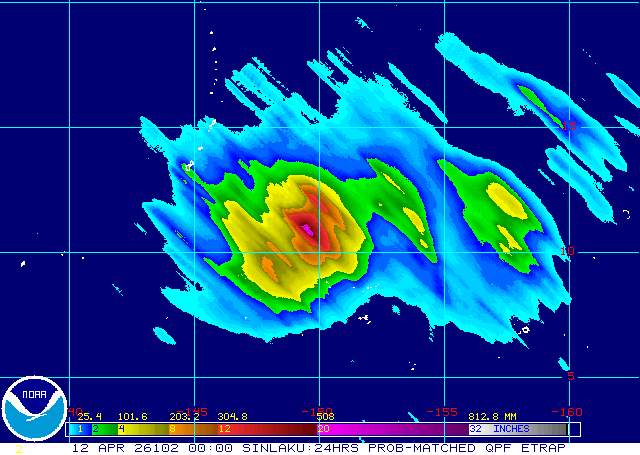
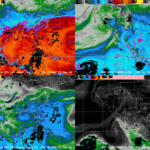
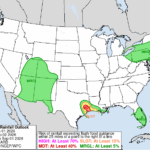
Sinlaku was the first monster typhoon of the 2026 season, reaching Category 5 intensity with maximum sustained winds of 180 mph. The typhoon impacted U.S. territories, including Guam and the Northern Mariana Islands, bringing strong winds and heavy rainfall. The NESDIS Ensemble Tropical Rainfall Potential (eTRaP) product provided situational awareness to the Guam NWS Weather Forecast Office (WFO), who shared the product output in a Facebook Live on 12 April 2026, showing over 20″ of rainfall in a 24-hour period in the convection moving towards the island. The eTRaP product relies on observations from several Low Earth Orbit (LEO) microwave sounders to create a rainfall forecast that depends on the expected track of the tropical cyclone (TC).
Himawari-9 Full Disk (FD) Infrared (IR) Band 13 imagery provided an ominous look at Typhoon Sinlaku’s approach, with a clear eye and very cold cloud tops surrounding the center of circulation.
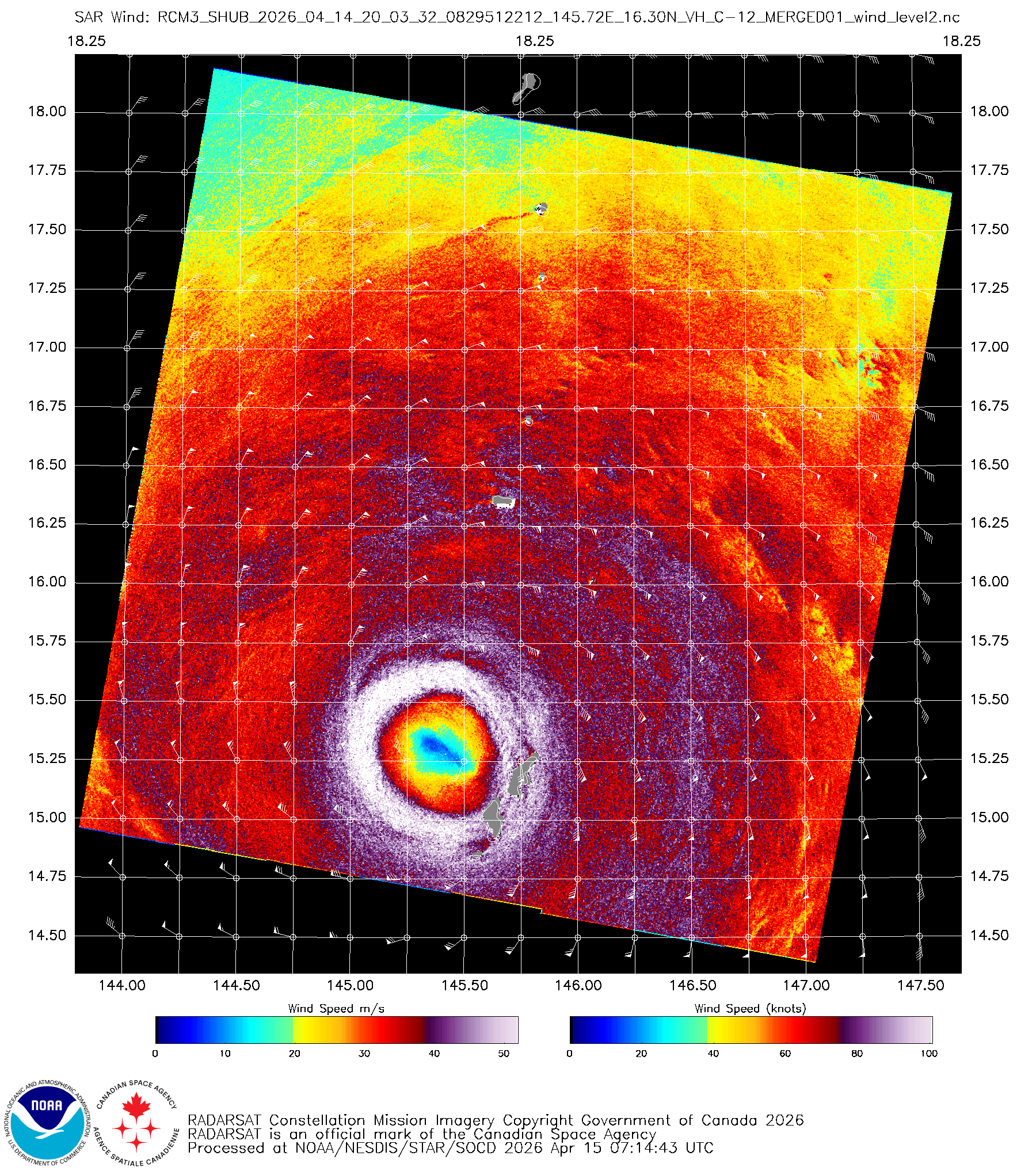
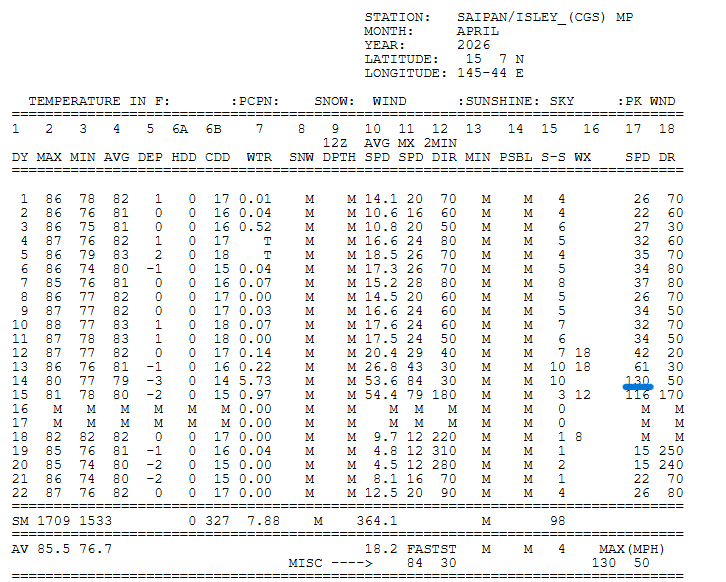
Synthetic Aperture Radar (SAR) based tropical winds were provided for Sinlaku as the typhoon moved across the Northern Mariana Islands. SAR is tasked for TCs based on forecast tracks, and the cross-polarization TC algorithm is automatically ran at 3-km spatial resolution to capture high wind speeds. As Sinlaku was just to the west of Saipan, RADARSAT Constellation Mission-3 (RCM-3) observed wind speeds near 100 knots in the eastern eyewall. Saipan International Airport observed wind speeds up to 130 mph.
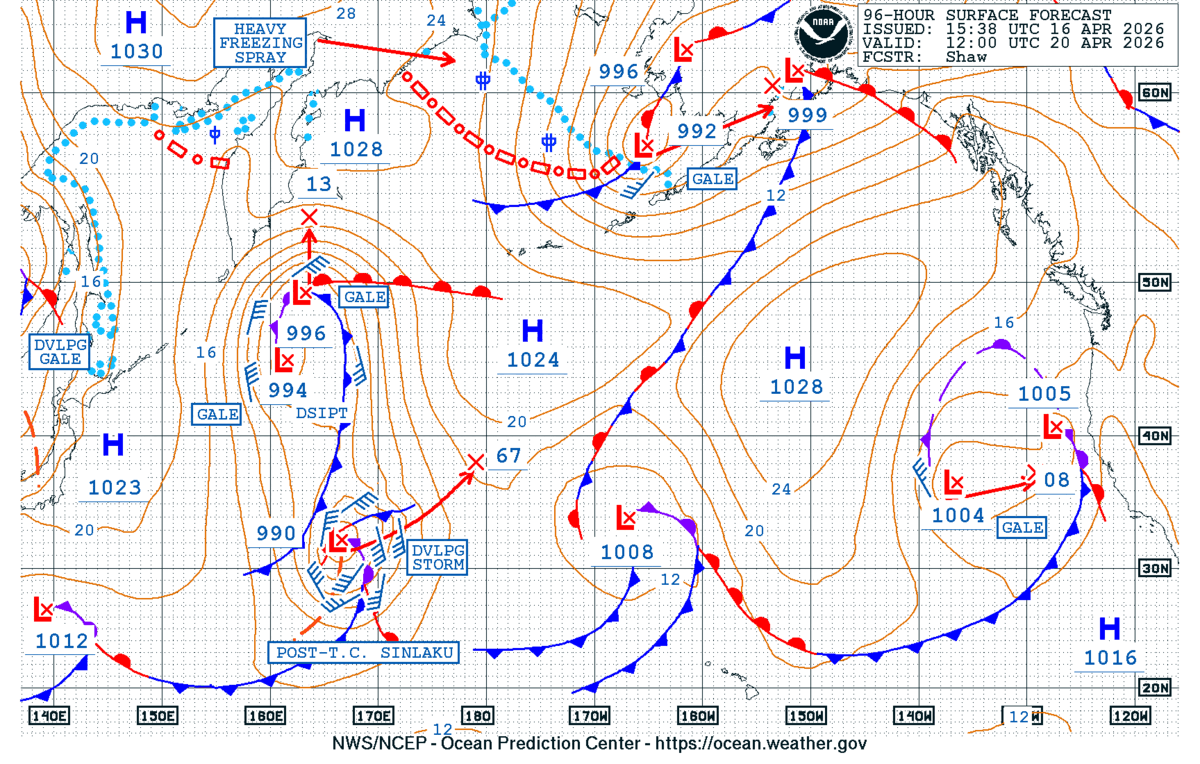
Four days in advance of its extratropical transition, the NWS Ocean Prediction Center was tracking post-TC Sinlaku as it ventured into OPC waters. The OPC was also tracking a system strengthening to its north. NWS OPC noted that the Western Pacific is notorious for developing potent lows near a recurving TC due to the available latent heat release.
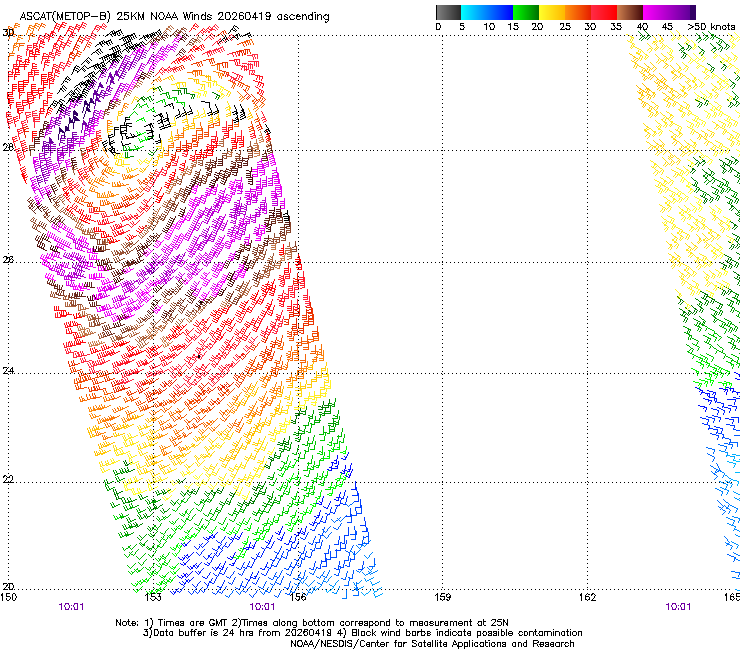
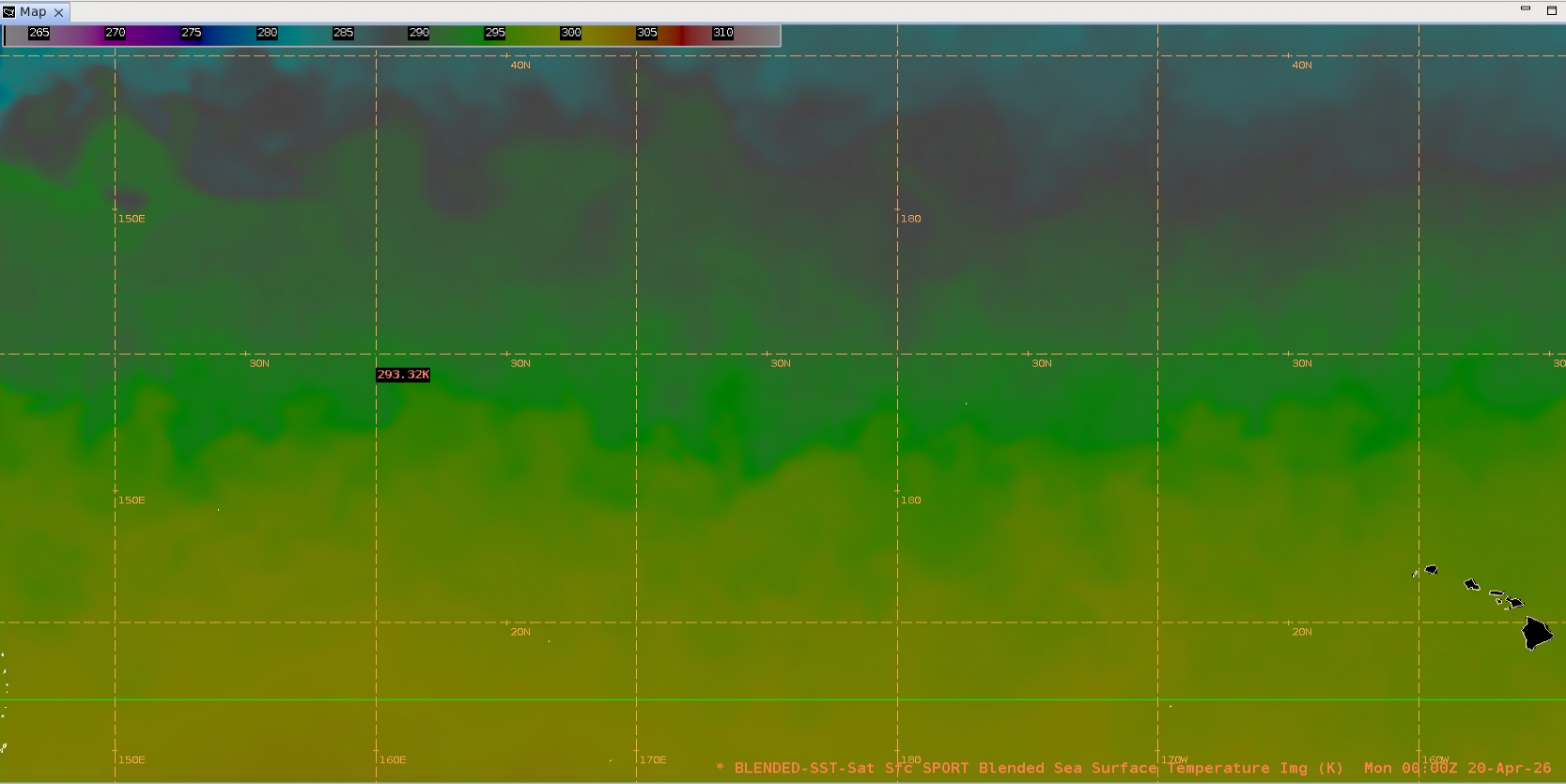
The extratropical transition of Typhoon Sinlaku was not particularly impressive. Himawari-9 Air Mass RGB imagery from ~1200 UTC 18 April to ~1800 UTC 19 April 2026 showed a loss of sustained convection near the center of circulation, and a deep tropical air mass (green colors) was replaced by warm, dry air (orange colors). A Metop-C scatterometer (ASCAT) pass at ~1000 UTC 19 April 2026 was also hinting that this transition was already underway, with the strongest winds found in the western quadrant, not the northeastern quadrant which is typical for TCs. By 0000 UTC 20 April 2026, Sinlaku was post-tropical. The NESDIS Geo-Polar Blended Sea Surface Temperature (SST) product indicated that SSTs near where Sinlaku became post-tropical were indeed quite cool, only around 20 degrees Celsius (~68 degrees F).
Figure 6: Himawari-9 FD Air Mass RGB imagery from 1200 UTC 18 April to 1740 UTC 19 April 2026. From CIRA Slider
There was a bit of a connection from Post-TC Sinlaku, tracking east along 30 degrees N, and the strengthening extratropical cyclone near Alaska’s Aleutian Islands. You can even see a bit of tropical air (green colors) injected into the system’s narrow warm sector. By 0600 UTC 22 April 2026, a 966 hPa storm-force low was located in the Southern Bering Sea, with a Heavy Freezing Spray Warning in effect near the ice edge to the north.
Figure 9: Himawari-9 FD Air Mass RGB imagery from 0600 UTC 21 April to 0000 UTC 22 April 2026. From CIRA Slider