Home » Cazzy Medley » Page 27

Author: Cazzy Medley

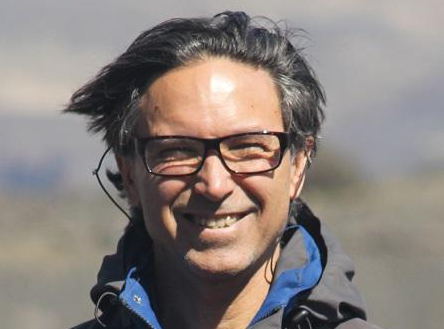
Santiago Gasso poses in front of a blurred landscape.

Gassó Talks Earth Science In Spanish Interviews

On the occasion of Earth Day, ESSIC Scientist Santiago Gassó was interviewed by several international and domestic media outlets for Spanish audiences. The interviews consisted of brief live and recorded video segments meant to highlight NASA’s commitment to Earth science observations since its inception.

Read More »
Figure1: Differences in SCAN observations‐based ubRMSE during 1 April 2015-30 August 2021 time period: (a) SMOPScdr minus SMAP, (b) SMOPScdr minus SMOS, (c) SMOPScdr minus AMSR-2, (d) SMOPScdr minus ASCATA. Patterns for ASCATA and ASCATB are very similar. Sites in blue color highlight better performance.

A New NOAA Blended Soil Moisture Product that Does Not Rely on Model Climatology

ESSIC/CISESS Scientists Jifu Yin, Jicheng Liu and Ralph Ferraro published a new article last month that discussed their work with NOAA’s Soil Moisture Operational Product System (SMOPS). SMOPS is developed by National Oceanic and Atmospheric Administration (NOAA) to provide the real time blended soil moisture (SM) for Numeric Weather Prediction and National Water Model applications.

Read More »
Figures 1 and 2: Snowfall rate from Pacific Northwest snowstorm on April 13, 2022, (left) NOAA-20 SFR, (right) NOHRSC

Microwave Snowfall Rate Product Captures Late Season Pacific Northwest Snowfall

The STAR scientist team of Huan Meng, Yongzhen Fan, Jun Dong, and Yalei You examined the performance of snowfall estimates from the passive microwave snowfall rate (SFR) product for the late season snowstorm that hit Washington and Oregon on April 13. The storm set the local record for most snow accumulation this late in the season, causing power outages and road closures across Portland, Oregon.

Read More »
The GEO Blue Planet flyer.

GEO Blue Planet Will Hold Symposium in Ghana

GEO Blue Planet, a network of ocean and coastal-observers, social scientists and end-user representatives, will hold its 5th Symposium from October 24-28, 2022. It will take place in-person in Accra, Ghana with a virtual component. This year’s theme will focus on GEO Blue Planet’s core actions areas, “capacity development, stakeholder engagement & cooperation & co-design driving sustained ocean and coastal observations for society”.

Read More »
Blended wind graph.

NOAA/NCEI Blended Sea Surface Winds Product for Resolving Hurricane Winds

ESSIC/CISESS Scientist Korak Saha and collaborator Huai-min Zhang have been improving the NOAA/NCEI Blended Seawinds (NBS) product. NBS blends several satellite estimates of surface wind, providing more accurate and gap-free observational data for model calibration and quality control. NOAA has been producing a global gridded 0.25-degree and 6-hourly sea surface winds product that has wide applications in marine transportation, marine ecosystem and fisheries, offshore winds, weather and ocean forecasts, among others.

Read More »
A coral, severely bleached to white.

NOAA Coral Reef Watch Provides Critical Early Warnings for the 2022 Mass Coral Bleaching Event on the Great Barrier Reef

For more than 20 years, NOAA Coral Reef Watch (CRW) has been the world’s leader in observing, predicting, and communicating changes in the coral reef environment to a diverse, global user community. In mid-December 2021, CRW’s daily global 5km-resolution satellite coral bleaching heat stress products detected a significant build-up of oceanic heat stress on the Great Barrier Reef (GBR), Australia. This signified the GBR was starting its 2021-2022 summer season with a much earlier onset of accumulated heat stress than ever recorded before. At the same time, CRW’s modeled Four-Month Coral Bleaching Heat Stress Outlook indicated the significant heat stress would continue, leading to a potential mass coral bleaching event on the GBR (following on the heels of confirmed mass bleaching events in 2016, 2017, and 2020).

Read More »