University of Maryland

Meteorological Summer Kicks Off with More Central U.S. Flooding

UMD/ESSIC/CISESS GOES-R Satellite Liaison for NWS WPC

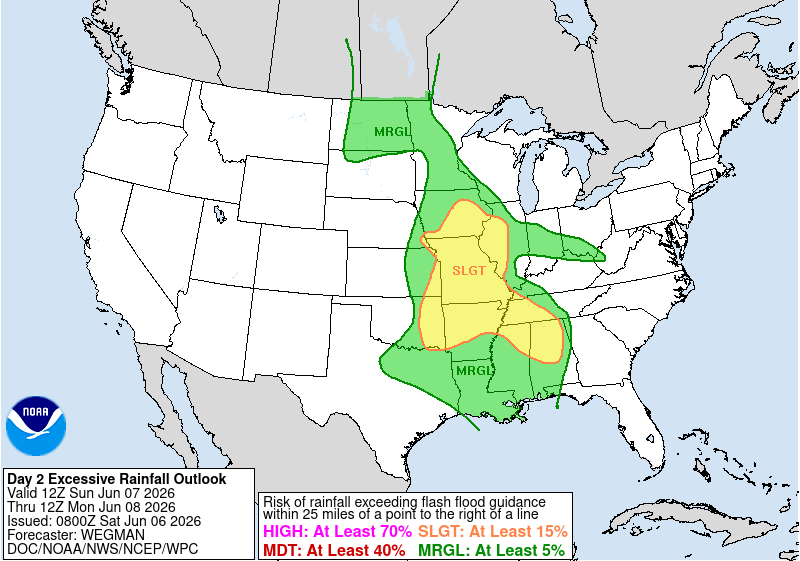
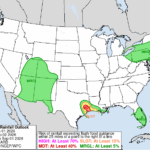
After most of Meteorological Spring was fairly quiet in terms of flash flooding across the U.S., that changed rapidly in the second half of May. Since 16 May 2026, there’s only been two days that the NWS Weather Prediction Center (WPC) issued a Marginal or lower risk Excessive Rainfall Outlook (ERO). Multiple areas of storms resulted in flash flooding from Missouri to Alabama on 07 & 08 June 2026, including NWS Huntsville, where just the third Flash Flood Emergency of 2026 was issued. NWS WPC captured this multi-state threat in their Day 2 ERO issued at 0800 UTC 06 June 2026, with a Slight Risk for excessive rainfall stretching across much of the Mississippi and Tennessee valleys.

NWS WPC ERO
Figure 1: NWS WPC ERO valid through 1200 UTC 08 June, issued at 0800 UTC 06 June 2026.

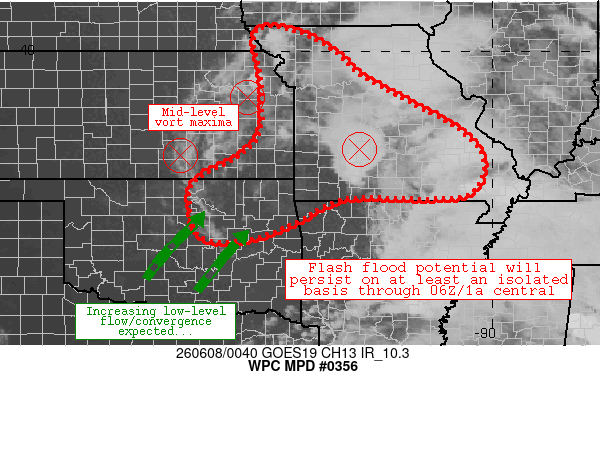
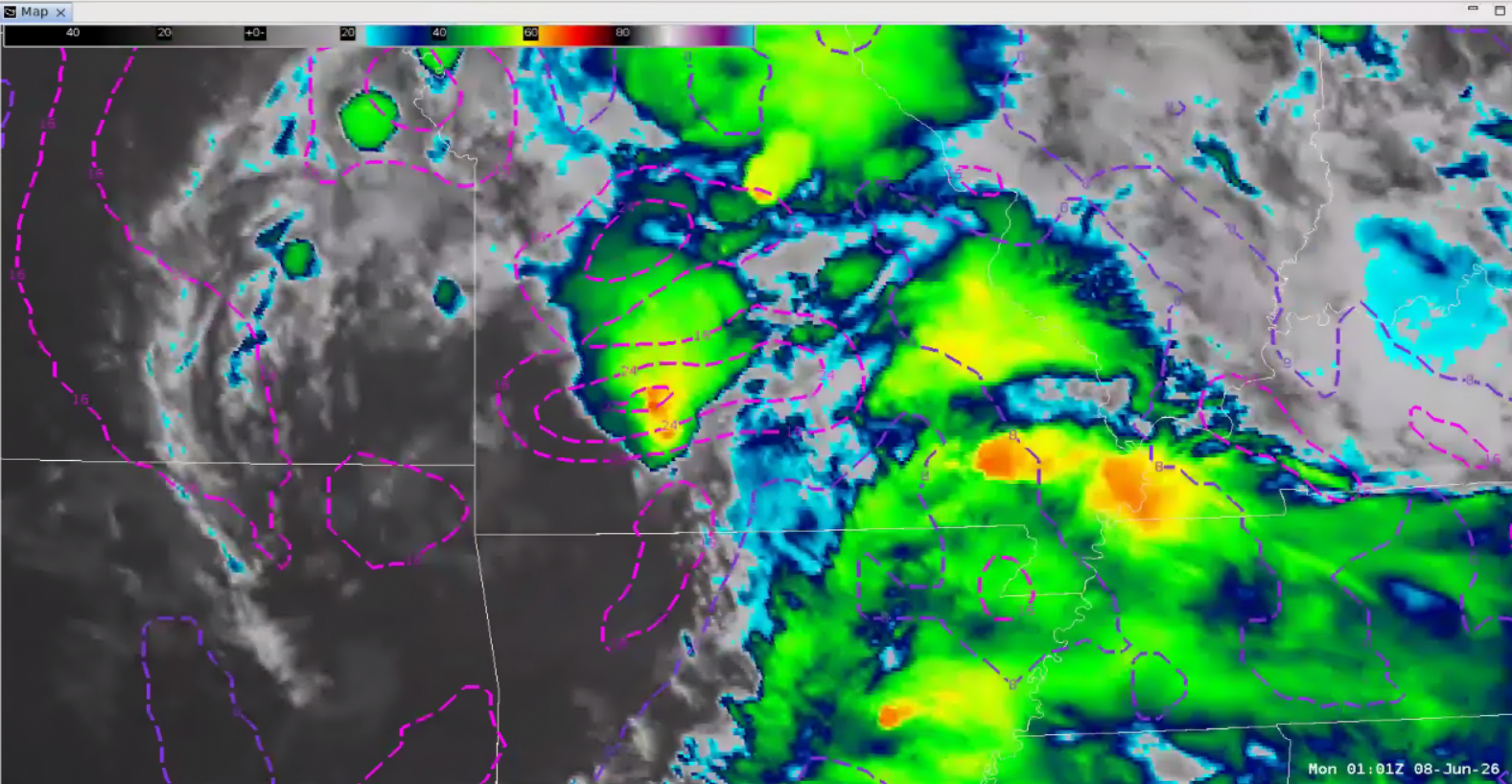
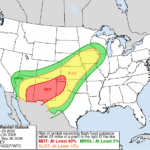
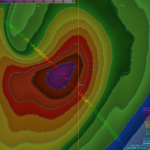
The WPC MetWatch Desk issued a Mesoscale Precipitation Discussion (MPD) at 0055 UTC 08 June 2026, highlighting the risk for flash flooding over the next six hours across northeastern OK and eastern KS, along with much of MO. In the MPD, a few areas of mid-level vorticity maxima were overlaid on grayscale GOES-East Band 13 infrared (IR) imagery. RAP 500 hPa analysis of vorticity overlaid on GOES-East IR imagery indeed confirmed a strong vorticity maximum beneath ongoing convection in MO.

WPC MPD issued at 0055 UTC 08 June 2026
Figure 2: WPC MPD issued at 0055 UTC 08 June 2026, with vorticity maxima overlaid on GOES-East IR imagery.
RAP 500 hPa vorticity overlaid on GOES-East IR imagery
Figure 3: RAP 500 hPa vorticity overlaid on GOES-East IR imagery at 0101 UTC 08 June 2026. This image was exported from AWIPS, and display files can be shared upon request.

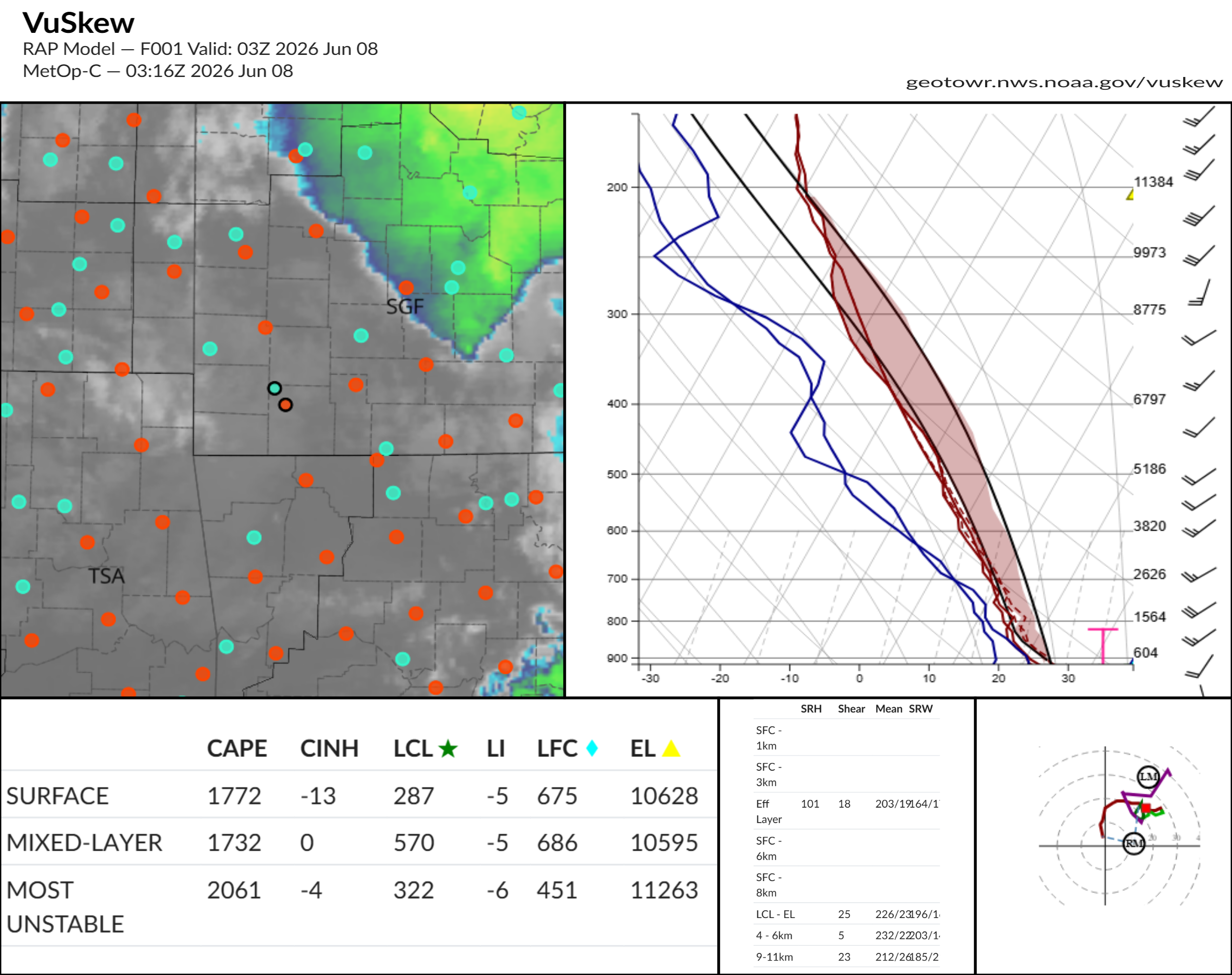
A Metop-C NUCAPS sounding in the TOWR-S VuSkew Tool a couple of hours later at ~0300 UTC confirmed an unstable environment to the southwest of the ongoing convection, with Most Unstable (MU) CAPE exceeding 2,000 J/kg. Sounding output from the 0300 UTC RAP initialization is also shown, with both soundings quite similar. NUCAPS is most reliable in areas with less cloud cover as infrared sounders have better retrievals. The VuSkew Tool is an integrated sounding viewer and accessible via VLAB with a NOAA account.

VuSkew Metop-C NUCAPS and RAP model sounding profiles
Figure 4: VuSkew Metop-C NUCAPS and RAP model sounding profiles in Southwest MO at ~0300 UTC 08 June 2026. From TOWR-S

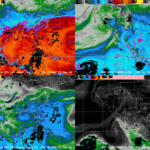
GOES-East CONUS Mid-Level Water Vapor (WV) Band 08 imagery from 1801 UTC 07 June to 1716 UTC 08 June showed a complex mid-level trough pushing east across the Middle Mississippi Valley, firing off rounds of convection upstream, including in AL, and a robust mesoscale convective system (MCS) in its wake.

Figure 5: GOES-East CONUS Mid-Level WV imagery from 1801 UTC 07 June to 1716 UTC 08 June 2026. This animation was exported from AWIPS, and display files can be shared upon request.

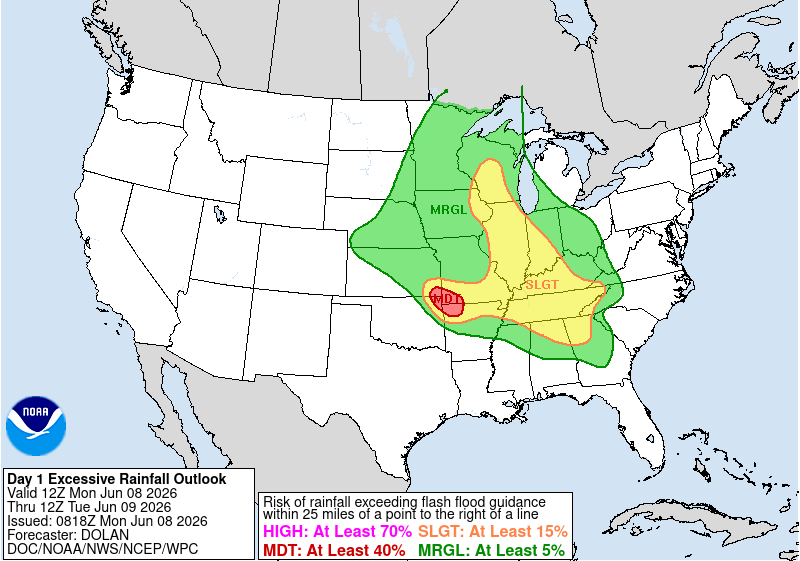
The origins of the MCS can be traced back in the GOES-East IR imagery to ~0430 UTC 08 June 2026, before becoming a mature complex of storms by ~0900 UTC. The MCS persisted for several hours, with extensive weakening occurring after ~1600 UTC. As a result of the repeating rounds of storms, WPC upgraded the Day 1 ERO to a Moderate Risk for a targeted area of Southwest MO and Northwest AR.

Figure 6: GOES-East CONUS IR imagery from 1801 UTC 07 June to 1711 UTC 08 June 2026. This animation was created from AWIPS, and display files can be shared upon request.

NWS WPC Day 1 ERO
Figure 7: NWS WPC Day 1 ERO valid through 1200 UTC 09 June, issued at 0818 UTC 08 June 2026.

GOES-East 1-minute Mesosector GLM Group Energy Density output from ~0800 to 1000 UTC 08 June 2026 showed that the MCS produced a prolific amount of lightning around the time of its peak intensity, especially over Southeast Kansas and Southwest MO.

Figure 8: GOES-East Mesosector 1-minute Geocolor imagery overlaid with the GLM Group Energy Density from ~0800 to 1000 UTC 08 June 2026. From CIRA Slider

An extremely active week of weather is expected once again, with four consecutive days of Moderate Risk EROs in the forecast, the first such instance since heavy rainfall associated with Hurricane Debby in 2024. This week’s heavy rainfall indeed has a connection to trouble brewing in the tropics.

Picture of Christopher Smith

Christopher Smith

Christopher Smith joined ESSIC/CISESS, University of Maryland in 2023 and is the GOES-R Satellite Liaison for the NWS Weather and Ocean Prediction Centers. Smith works to interpret experimental satellite imagery and products, and make such products available to forecasters and the NWS for a route to operations. He trains forecasters how to use satellite imagery in weather forecasting, while also delivering forecaster feedback to satellite developers to maximize meteorological satellite capabilities. Smith is an alumni of the UMD Atmospheric & Oceanic Science (AOSC) Department, and his long-term interests include infusing AI-Satellite Products to increase lead time in decision making for forecasters.